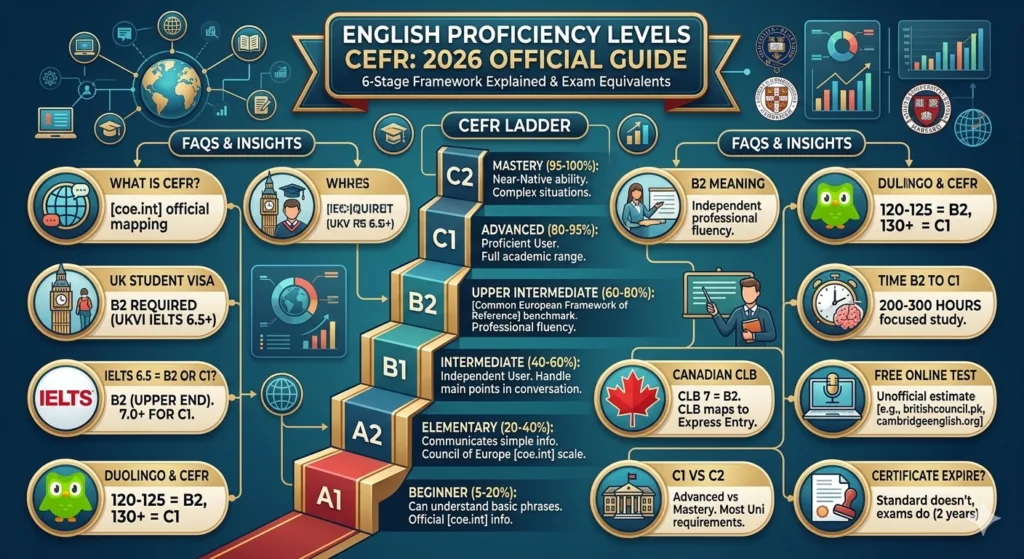
Navigating the English proficiency levels CEFR is essential for anyone planning to study or work abroad in 2026. Specifically, the Common European Framework of Reference for Languages (CEFR) provides a standardized way to describe your language skills on a scale from A1 (Beginner) to C2 (Proficient). Currently, most global universities and immigration departments—including those in the UK, Canada, and Europe—use these benchmarks to set their entry requirements.
While an A-level student might reach a B2 level, competitive postgraduate programs now frequently demand a C1 Advanced rating. Ultimately, mastering these levels ensures your qualifications are recognized internationally, giving you a clear roadmap toward academic and professional success.
Most learners don’t—and that’s a huge mistake.
Whether you’re preparing for IELTS, TOEFL, PTE, or just trying to improve your English fluency, understanding your English proficiency level is essential. From choosing the right class and books to taking the appropriate exam, knowing your level can make or break your learning journey.
Let’s dive into the six official CEFR levels of English, explained in simple terms with examples—and help you figure out where you stand.
Why You Must Know Your English Level
Here’s why it’s crucial to assess your English level:
1. Choose the Right Class
Enroll in a class that’s too easy, and you’ll waste time. Too hard, and you’ll feel lost. Knowing your level ensures your learning is efficient and enjoyable.
2. Buy the Right Books
Study materials are often divided by levels. The wrong book can be either too advanced (frustrating) or too basic (boring).
3. Take the Right Exam
Exams like IELTS, TOEFL, and Cambridge English tests are designed for specific levels. If you take an exam that’s too difficult, you might fail. Too easy, and it won’t reflect your true ability.
Bottom line: Knowing your level saves time, money, and effort.
What Are the CEFR Levels?
The Common European Framework of Reference for Languages (CEFR) classifies English into six levels:
| Level | Name | Description |
|---|---|---|
| A1 | Beginner | Basic use of simple phrases |
| A2 | Elementary | Simple conversations and interactions |
| B1 | Intermediate | Practical everyday communication |
| B2 | Upper Intermediate | Confident and fluent conversation |
| C1 | Advanced | Complex, professional communication |
| C2 | Proficient | Near-native fluency and precision |
Let’s Break It Down (With Examples)
A1 Level – Beginner
You can use basic tenses like:
- Present Simple: “I live in Lahore.”
- Present Continuous: “I am cooking lunch.”
- Past Simple: “I watched a movie yesterday.”
Sample Question:
What is your favorite food?
You can answer in short, clear sentences. You can describe your city, your family, or your daily routine—but conversations are simple.
A2 Level – Elementary
You can:
- Ask and answer questions in shops
- Understand and use common expressions
- Use Present Perfect and Future Tense (will)
Sample Question:
How often do you go shopping?
You can talk about experiences, use polite expressions, and handle simple real-life tasks in English.
B1 Level – Intermediate
You’ve reached a strong, working knowledge of English. You can:
- Use all past and present tenses
- Understand modal verbs (can, should)
- Use zero and first conditionals
- Begin using passive voice and touch on past perfect
Sample Question:
What was the last film you watched?
Answers now become more detailed. You’re not just answering the question—you’re telling a story.
B2 Level – Upper Intermediate
This is a powerful level—many students stop here, but it’s just the beginning.
At B2, you can:
- Use all English tenses, including:
- Present Perfect Continuous
- Past Perfect Continuous
- Future Perfect
- Express opinions clearly
- Use varied vocabulary
Sample Question:
What qualities do you look for in a good friend?
You’re now building arguments, using abstract vocabulary, and transitioning between ideas with ease.
C1 Level – Advanced
Now you’re at a professional level. You can:
- Talk about complex ideas
- Read and write long texts
- Understand idioms and figurative speech
- Speak fluently with minor pauses
Sample Question:
How do you think future fashion trends will affect society?
Your vocabulary range is vast. You don’t just talk—you explain, persuade, and analyze.
C2 Level – Proficient
You’re practically fluent—like a native speaker. You can:
- Speak at natural speed with confidence
- Handle academic, legal, or technical topics
- Use nuanced language and cultural references
Sample Question:
People make assumptions based on clothing. What’s your opinion?
At C2, you can explore social behavior, psychological perspectives, and support arguments with real-life examples—without hesitation.
How to Test Your Level
There are many free level tests online. Search for “CEFR English level test” and choose a trusted source like:
- Cambridge English
- British Council
- EF Standard Test
Tip: Don’t rely on one test. Try 2–3 and compare results.
FAQs: English Proficiency Levels CEFR (2026 Official Guide)
What are the six English proficiency levels CEFR?
The framework organizes language ability into six distinct stages. Specifically, these range from . Currently, the Council of Europe groups these into three broad categories: Basic User (A1, A2), Independent User (B1, B2), and Proficient User (C1, C2). Ultimately, identifying your stage helps you choose the right study materials and .
Which CEFR level is required for a UK Student Visa in 2026?
Most degree-level students must prove a minimum of . Significantly, the UK Home Office updated its guidance in January 2026, raising the standard for key routes like the Skilled Worker and HPI visas to B2 as well. However, if you are studying below degree level, a B1 level remains the minimum requirement. Consequently, you should confirm that your matches the level demanded by your university’s CAS.
Is IELTS 6.5 equivalent to B2 or C1?
An IELTS score of 6.5 typically maps to the upper end of the . Specifically, official mapping research shows that while some 6.5 test-takers reach C1, a score of 7.0 or higher provides the “high degree of confidence” required for a true C1 Proficient rating. Therefore, if your dream university asks for “C1,” you should aim for a minimum IELTS band of 7.0 to guarantee eligibility.
Can I use the Duolingo English Test to prove my CEFR level?
Yes, the Duolingo English Test (DET) aligns its scoring directly with the CEFR scale. Currently, a is considered equivalent to B2. Furthermore, scoring 130 or above places you firmly in the C1 Proficient category according to . Ultimately, the DET is a fast and affordable way to certify your English proficiency levels CEFR for thousands of global institutions.
What does “B2 Level” actually mean for a student?
A B2 level signifies you are an “Independent User” who can communicate effectively in a professional environment. Specifically, you can in your field of interest. Moreover, this is the most common entry requirement for undergraduate programs worldwide. Consequently, reaching B2 ensures you can participate in lectures and write academic essays without constant translation help.
How long does it take to move from B2 to C1?
Moving from B2 to C1 typically requires between 200 and 300 hours of focused study. Significantly, this jump is often the hardest because it requires mastering implicit meaning and sophisticated professional vocabulary. While many students reach B2 quickly, achieving C1 requires immersion and advanced . Ultimately, consistency is more important than speed when trying to reach the “Proficient User” stage.
Are CEFR levels recognized for Canadian immigration in 2026?
Canada uses the Canadian Language Benchmarks (CLB), which map directly to IELTS and other tests. Specifically, a is equivalent to a B2 level or an IELTS 6.0 in all components. Currently, the Canadian government accepts multiple tests including IELTS General, CELPIP-General, and . Therefore, understanding the CEFR framework helps you predict your success in Canadian immigration points (CRS).
How can I test my CEFR level for free online?
You can use several high-quality tools to get an unofficial estimate of your level. Specifically, the provides a quick result aligned with the CEFR. Furthermore, Cambridge English offers a to help you decide which official certificate to pursue. However, remember that these free tests are for guidance only and cannot be used for official visa applications.
What is the difference between C1 and C2?
C1 represents “Advanced” English, while C2 is “Mastery” or near-native proficiency. Specifically, a C1 user can handle almost all academic and professional tasks. In contrast, a and express themselves with absolute precision in complex situations. Significantly, most universities and employers only require C1, making C2 a prestigious but optional goal for most international students.
Do CEFR certificates expire?
The CEFR framework itself is a permanent standard, but the exams proving your level—like —usually expire after two years. Specifically, the UK and Canadian governments want to see “recent” proof of your skills to ensure they are current. Consequently, you should time your proficiency test so that your results are valid during your entire application and visa process.
Final Thoughts: Your Level Is Not Your Limit
Your English level is just a starting point. It’s not a label. It doesn’t define your intelligence or your future.
Many learners stay at B2 and plateau—but if you keep practicing, reading, writing, and speaking, you can reach C1 and C2. It’s all about consistency and mindset.
“Your fluency grows not just by learning rules—but by using English every single day.”
So… What’s your level?
Let us know in the comments! And if you found this guide helpful, share it with your classmates, teachers, or friends.

Englopak is Pakistan’s premier gateway for international education, career development, and language proficiency. Founded on the principle of bridging the gap between local potential and global excellence, we provide a 360-degree ecosystem for students and professionals aiming for the USA, UK, Germany, Norway, and beyond.
Furthermore, we understand that a global journey is more than just an application—it is a life-changing transition. Consequently, we prioritize technical accuracy in document attestation, financial certification, and interview preparation.
At Englopak, your global future isn’t just a dream—it’s a plan.
Phone Numbers
1. Rawalpindi : 0315 9117529
2. Islamabad: 0315 9956772
3. Peshawar: 0342 0092051
Info@englopak.com
Englopakdigital@gmail.com
Englopakinstitutes@gmail.com