
Pakistan’s Taimoor Cruise Missile: A Major Leap in National Defence Capability
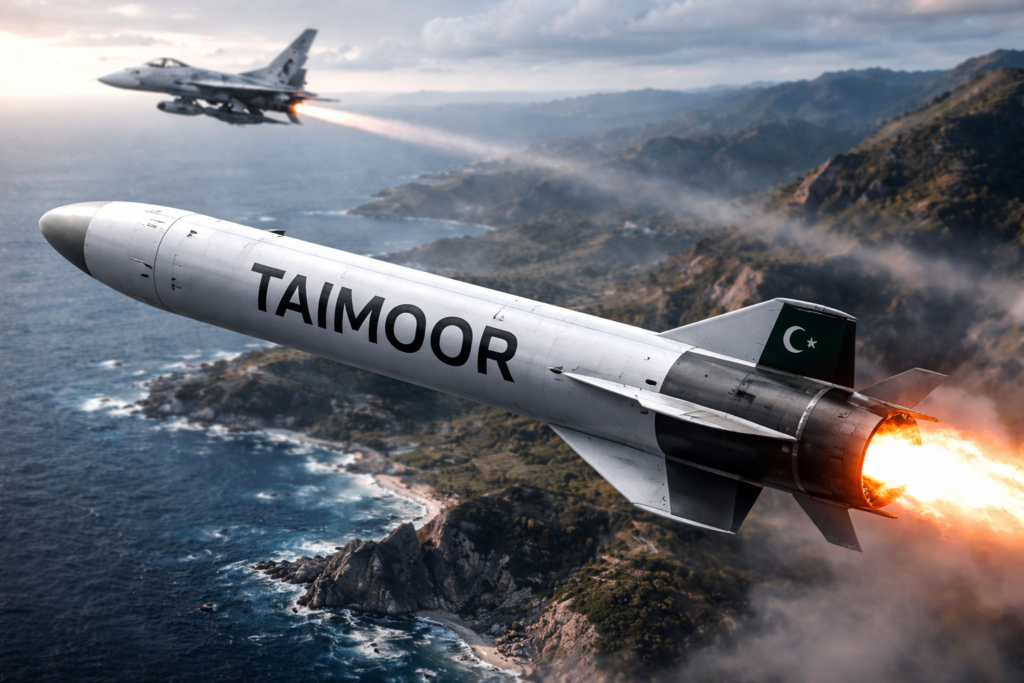
The Pakistan Air Force (PAF) recently conducted a successful flight test of its indigenously developed Taimoor air-launched cruise missile, marking a historic milestone in the country’s defence capabilities.
The test was officially confirmed by military sources and showcased the missile’s ability to strike targets with high accuracy over a range of 600 kilometers, demonstrating Pakistan’s growing technological proficiency in modern warfare systems.
Indigenous Development and Strategic Importance of the Taimoor Cruise Missile
The Taimoor missile represents a significant achievement for Pakistan’s defence industry, developed with substantial local expertise and scientific ingenuity.
Capable of engaging both land and sea targets, the missile enhances Pakistan’s conventional deterrence posture in a region marked by evolving security challenges.
Air-Launched Design and Precision Strike Capabilities
One of the key features of the Taimoor system is its air-launched profile, allowing it to be deployed from fighter aircraft at stand-off distances.
During the recent test, the missile exhibited low-altitude flight characteristics and terrain-hugging navigation, enabling it to evade advanced enemy radar and air defense systems more effectively.
Advanced Navigation and Guidance Systems Empowering Accuracy
The Taimoor cruise missile is equipped with a state-of-the-art navigation and guidance system that improves precision targeting even when traditional satellite navigation may be challenged.
This technological sophistication ensures higher mission success rates against strategic targets.
Low-Altitude Flight Enhances Survivability and Operational Flexibility
Designed to operate at very low altitudes, the Taimoor missile’s terrain-skimming flight path significantly reduces its detectability by hostile air and missile defence assets.
This low-observable profile increases its likelihood of penetrating deep into contested airspace.
Impact on Pakistan’s Defence Strategy and Conventional Deterrence
The integration of Taimoor into the PAF’s arsenal strengthens Pakistan’s conventional deterrence strategy, as it provides a credible long-range precision strike option without escalatory reliance on nuclear-armed systems.
This capability is crucial for maintaining strategic balance in South Asia.
Historical Context and Evolution of Pakistan’s Cruise Missile Program
The Taimoor missile builds on Pakistan’s legacy of cruise missile development, following systems like the Ra’ad and Ra’ad-II, which established foundational cruise missile technologies in the region.
By refining these technologies into the modern Taimoor system, Pakistan continues to advance indigenous aerospace capabilities.
Regional Security Dynamics and Strategic Significance
Analysts and defence observers note that the successful test of the Taimoor missile will likely influence regional security dynamics, prompting neighbouring powers to reassess defence postures and deterrence frameworks.
The missile’s reach and precision strike capability introduce a new variable into South Asia’s strategic calculations.
Technological Self-Reliance and National Defense Industry Growth
The Taimoor cruise missile’s development reflects Pakistan’s growing emphasis on technological self-reliance in defense production.
By cultivating domestic research, design, and manufacturing capabilities, Pakistan aims to reduce dependence on foreign suppliers and enhance national security infrastructure.
Future Prospects and Operational Integration into the PAF Fleet
Moving forward, the Pakistan Air Force is expected to integrate Taimoor into operational service more broadly, potentially pairing it with a variety of combat aircraft to expand its strike options.
This evolution signifies a deeper shift in PAF’s strategy towards versatile, stand-off precision weapons.
In conclusion, the successful flight test of the Pakistan Taimoor cruise missile represents both a technological and strategic achievement.
It underscores Pakistan’s commitment to strengthening its defense capabilities, enhancing regional deterrence, and fostering advanced indigenous military systems.