Many people in Australia are searching one key topic again and again: UK passport dual citizenship. Some want a British passport for family reasons. Some plan to move for work or study. Others simply want long-term options in two countries.
This guide explains what dual citizenship means for Australia and the UK, who may qualify, how the process usually works, and what to watch out for.
Important note: This article is general information. It is not legal advice. Rules can change. Always confirm details with official government sources.
Why “UK passport dual citizenship” is trending in Australia
Search trends often rise when people feel urgency. In Australia, the most common drivers are:
- Family ties to the UK (parents, grandparents, or children living in Britain).
- Career mobility for professionals who want the UK job market option.
- Study plans for the UK or Europe.
- Lifestyle decisions like retirement planning or long-term relocation.
- Travel rule changes that push dual nationals to use the correct passport when they travel.
For example, Australia reminds dual citizens to enter and leave Australia on an Australian passport.
In the UK, the government confirms that dual citizenship is allowed and you do not “apply” for dual citizenship as a separate status. You simply hold two nationalities if both countries permit it.
What dual citizenship means (in simple words)
Dual citizenship means you are a citizen of two countries at the same time.
If you hold Australian citizenship and British citizenship, you can usually:
- Live, work, and study in both countries (subject to each country’s rules).
- Hold two passports (one Australian, one British).
- Pass citizenship to children in certain situations (rules depend on your status and your child’s place of birth).
The UK explicitly allows dual nationality.
Australia also allows dual citizenship, with clear travel guidance for dual citizens.
Quick clarity: A UK passport is not the first step
Many people think they can “apply for a UK passport” directly.
In most cases, you must first be a British citizen (or have a form of British nationality that qualifies for a passport). After that, you apply for the British passport.
So the real question becomes:
How can you become a British citizen (while living in Australia)?
Let’s break it down.
Who may qualify for British citizenship in Australia
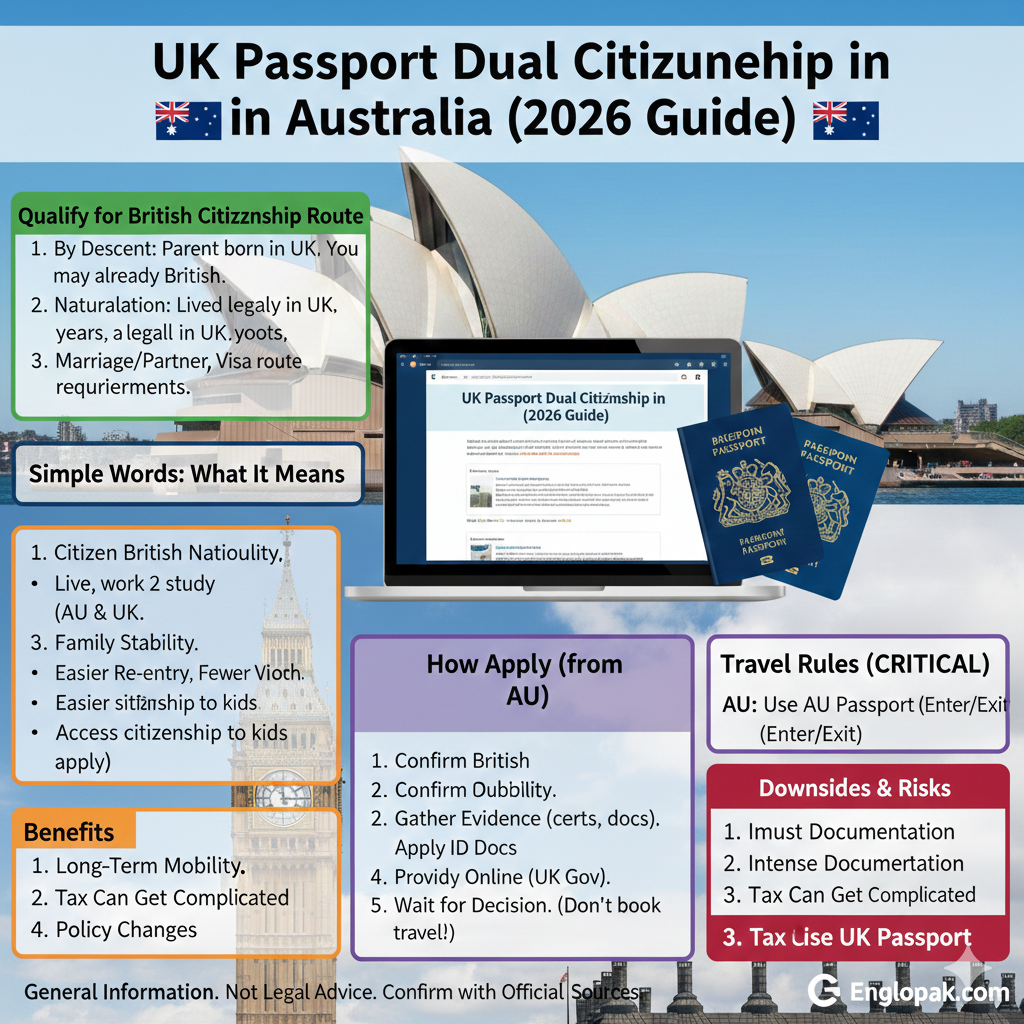
1) British citizenship by descent (through a parent)
If you have a British parent, you may be eligible. The exact rule depends on:
- Where you were born
- Your date of birth
- Your parent’s status at the time of your birth
- Sometimes, your parents’ marriage status (for older cases)
The UK government provides an official route checker for people who have a British parent.
Good sign: Your parent was born in the UK and held British citizenship when you were born.
Common result: You may already be British “by descent,” and then you can apply for a UK passport.
2) British citizenship by naturalisation (after living in the UK)
This path usually applies if you:
- Lived in the UK legally for years
- Met residence requirements
- Achieved “settled status” or indefinite leave to remain
- Met good character and other requirements
The Home Office’s naturalisation guide explains the legal requirements and the evidence you may need.
3) Citizenship through marriage or a UK partner route (indirectly)
Marriage alone does not automatically give you citizenship. But it may support a visa route that later leads to settlement and then naturalisation.
If you are in this category, you should plan for a longer timeline and stronger documentation.
Can you hold both passports legally?
Does the UK allow dual citizenship?
Yes. The UK allows dual citizenship.
Does Australia allow dual citizenship?
Australia allows dual citizenship and gives specific travel instructions for dual citizens.
So, in most normal cases, UK–Australia dual citizenship is possible.
But one more thing matters:
If you are also a citizen of a third country, that third country may restrict dual nationality. Always check that country’s rules.
Travel rules dual citizens must follow (this part saves people from airport stress)
Dual nationals often face trouble at the airport because they use the wrong passport.
Entering and leaving Australia
Australia’s Home Affairs guidance is clear: if you are an Australian citizen, you should use your Australian passport to enter and leave Australia.
Entering the UK as a British citizen
If you are British, you are expected to show your British status when you travel. In practice, that usually means using a valid UK passport.
This has become more important as the UK rolls out new travel permission systems (ETA) for many visitors. UK parliamentary research explains that British citizens are exempt from ETA, but dual nationals may face complications if they try to travel on a foreign passport.
Simple rule to follow:
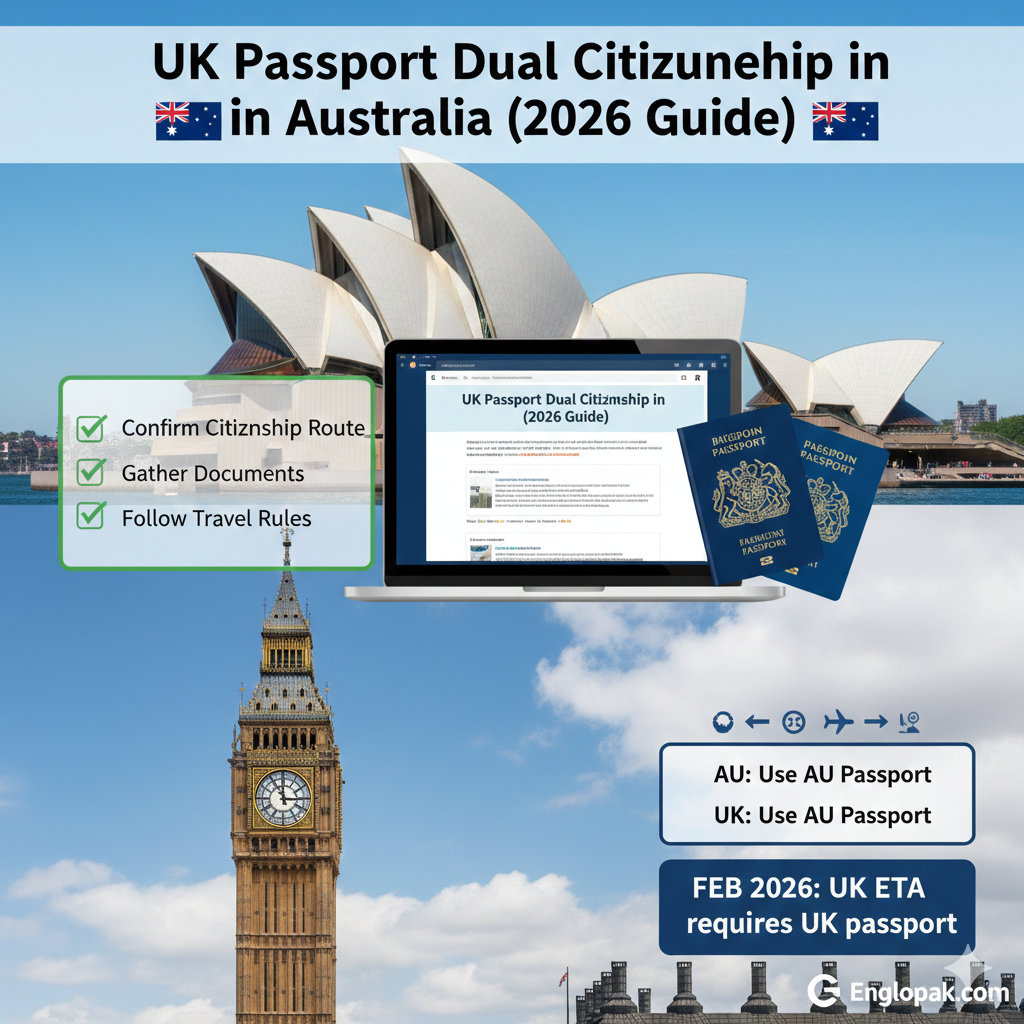
- Australia: Use Australian passport in and out.
- UK: Use your UK passport to enter the UK as a British citizen.
Benefits of UK passport dual citizenship for people in Australia
Here are the most practical benefits. These are the reasons people search this topic.
1) Long-term mobility
A UK passport gives you a strong “Plan B.” You can relocate for work, family, or study when needed.
2) Family stability
If your close family lives in the UK, British citizenship can reduce long-term immigration stress. It can also help with future planning for children (depending on the case).
3) Easier re-entry and fewer visa problems
Citizens do not rely on visitor visas or temporary permission.
4) Access to services and rights (country-specific)
Each country has its own system. You should confirm details for healthcare, education, and benefits based on your residency status.
Possible downsides and risks (be honest before you apply)
Dual citizenship is powerful, but it comes with responsibilities.
1) You must follow passport rules
Australia expects you to use your Australian passport to travel in and out.
Using the wrong passport can cause delays.
2) Documentation can be intense
British nationality cases can be straightforward, or very complex. Small details can change the outcome.
3) Tax and reporting can get complicated
Tax rules depend on where you live and where your income comes from. The UK has many agreements to reduce double taxation, but you should still get professional advice if you have cross-border income.
4) Policy changes can affect some groups
Citizenship and immigration policy can change, especially in special categories. Always verify your route and eligibility with official sources.
How to apply for a UK passport from Australia (typical steps)
If you are already British (or once you become British), you can apply for your UK passport from outside the UK.
Here is the usual flow:
- Confirm your British nationality status (by descent, registration, or naturalisation).
- Gather evidence (birth certificates, parents’ documents, marriage records, name change evidence, etc.).
- Apply from overseas using the UK government process and approved application routes. UK passport guidance exists for applicants applying from outside the UK.
- Provide identity documents safely and correctly.
- Wait for a decision and respond quickly if they request extra evidence.
Tip: Do not book non-refundable travel until you have your passport in hand. This is a common warning in official guidance.
Common mistakes Australians make when chasing a UK passport
Mistake 1: Confusing ancestry with citizenship
Having a UK-born grandparent does not automatically make you British. Some people qualify through special routes, but you must check your exact case.
Mistake 2: Missing “small” details
Dates matter. Places of birth matter. Marriage history can matter in older cases.
Mistake 3: Submitting weak scans or inconsistent names
If your documents show different spellings, you should explain it with official name-change evidence.
Mistake 4: Using the wrong passport while travelling
This causes airport stress. Follow the dual citizen travel guidance.
UK passport dual citizenship: Frequently asked questions (Australia-focused)
Can I keep my Australian passport if I get a UK passport?
In most cases, yes. Both countries allow dual citizenship.
Do I need to “apply for dual citizenship” in the UK?
No. The UK does not require a separate dual citizenship application. The UK government says dual citizenship is allowed and you can hold another nationality.
Do dual citizens need to use a specific passport for Australia?
Yes. Australia advises dual citizens to use their Australian passport to enter and leave Australia.
If I travel to the UK, can I use my Australian passport?
If you are also British, you should expect to prove your right of abode as a British citizen. Recent UK travel permission systems have made this more sensitive for dual nationals who try to travel as “visitors” on a foreign passport.
If I have a British parent, do I automatically get a UK passport?
Not always automatically, but you may be eligible for British citizenship depending on when and where you were born and your parent’s situation.
A smart checklist before you start your UK passport plan
Use this checklist to stay organized:
- Confirm your citizenship route (by descent / registration / naturalisation).
- Collect all civil documents (birth, marriage, divorce, name changes).
- Make sure names and dates match across documents.
- Plan travel with correct passport use in mind.
- If your case is complex, get professional guidance early.
Dual citizenship is not just a passport. It is a long-term strategy.
A UK passport is valuable. But the smartest approach is not speed. It is accuracy.
If you live in Australia and you are searching “UK passport dual citizenship,” start by confirming your citizenship status. Then build your documentation step by step. Follow travel rules. Keep your records clean. And make decisions that match your long-term plan for family, work, and education.
If you want Englopak to publish more guides like this—covering study, migration pathways, and document planning—explore more articles on Englopak.com and share your topic request with our team.
OR KNOW ABOUT US
Official UK & Australia Dual Citizenship Resources
| Resource Name | Official Website Link |
|---|---|
| UK British Citizenship Checker | gov.uk/check-british-citizenship |
| UK Overseas Passport Application | gov.uk/overseas-passports |
| UK Dual Citizenship Policy | gov.uk/dual-citizenship |
| UK Naturalisation Guide (Form AN) | gov.uk/become-british-citizen |
| UK ETA Eligibility & Rules | gov.uk/check-electronic-travel-authorisation |
| Australia Home Affairs: Dual Citizenship | homeaffairs.gov.au/dual-citizens |
| Australia Travel Advice: Dual Nationals | passports.gov.au/dual-nationals |
| UK High Commission Australia (Advice) | uk.embassy.gov.au/dual-nationals |

Englopak is Pakistan’s premier gateway for international education, career development, and language proficiency. Founded on the principle of bridging the gap between local potential and global excellence, we provide a 360-degree ecosystem for students and professionals aiming for the USA, UK, Germany, Norway, and beyond.
Furthermore, we understand that a global journey is more than just an application—it is a life-changing transition. Consequently, we prioritize technical accuracy in document attestation, financial certification, and interview preparation.
At Englopak, your global future isn’t just a dream—it’s a plan.
Phone Numbers
1. Rawalpindi : 0315 9117529
2. Islamabad: 0315 9956772
3. Peshawar: 0342 0092051
Info@englopak.com
Englopakdigital@gmail.com
Englopakinstitutes@gmail.com