Top Universities Abroad for Pakistani Students in 2026
Choosing the right university is one of the most important decisions when planning to study abroad. Pakistani students need universities that offer quality education, affordable tuition, scholarships, and post-study opportunities.
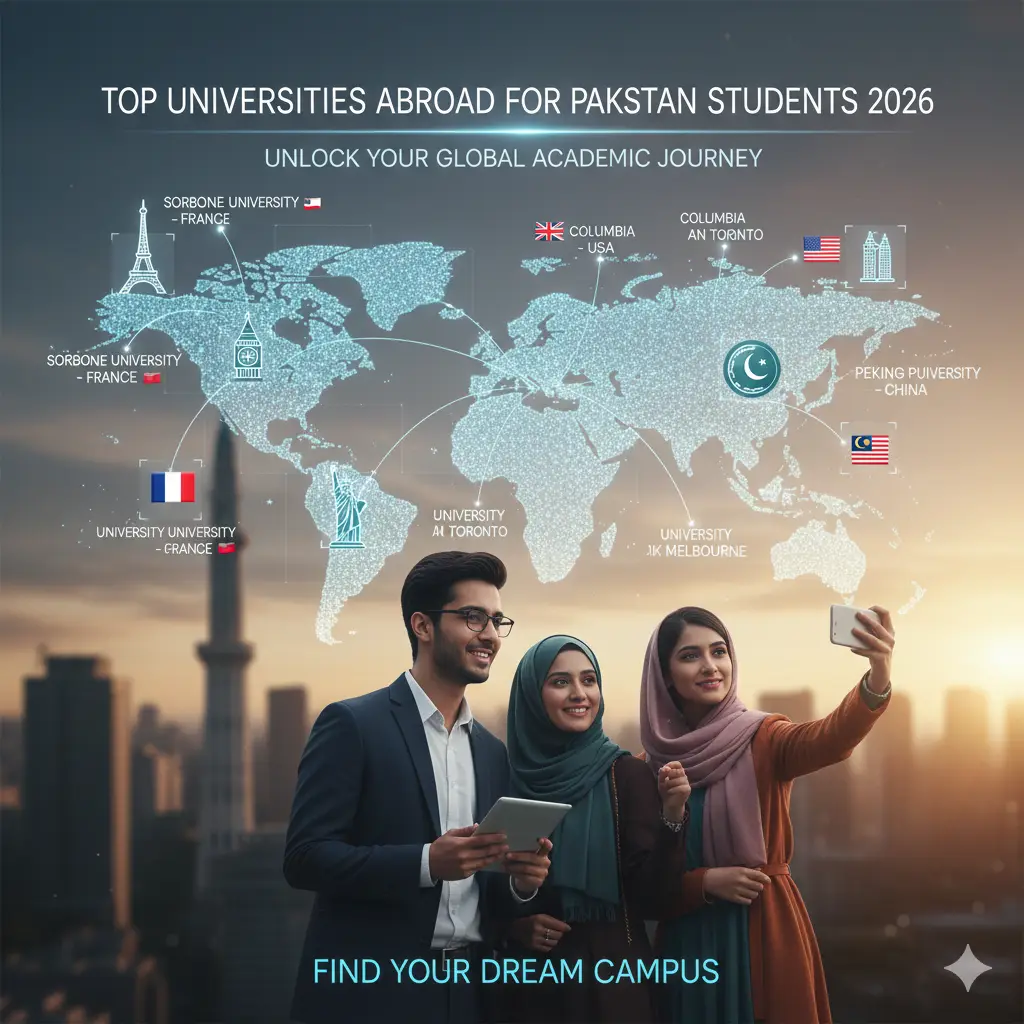
This guide lists the top universities abroad for Pakistani students in 2026, including popular programs, tuition fees, and key benefits.
Why Choosing the Right University Matters
The university you choose affects:
- Education quality
- Global recognition of your degree
- Scholarship and funding opportunities
- Post-graduation work and immigration options
- Networking and career opportunities
Studying at a top-ranked university increases your chances of career success and long-term growth.
Top Universities for Pakistani Students in bird eye view
United States: MIT, Stanford, Harvard, UC Berkeley, Cornell.
- United Kingdom: Oxford, Cambridge, Imperial College London, UCL, University of Manchester.
- Canada: University of Toronto, McGill University, University of British Columbia (UBC).
- Australia: University of Melbourne, University of Sydney, UNSW Sydney, ANU.
- China: Tsinghua University, Peking University, Fudan University, Zhejiang University.
- Germany: Technical University of Munich, LMU Munich, Heidelberg University.
- Turkey: Middle East Technical University (METU), Istanbul Technical University, Koç University.
- Singapore: National University of Singapore (NUS), Nanyang Technological University (NTU).
Top Universities for Pakistani Students
1. Harvard University – United States
- Location: Cambridge, Massachusetts
- Popular Fields: Business, Law, Engineering, Medicine
- Tuition Fees: ~$50,000/year
- Why Choose Harvard:
- World-renowned reputation
- Access to top research facilities
- Strong alumni network
- Multiple scholarships available
2. University of Toronto – Canada
- Location: Toronto, Ontario
- Popular Fields: Computer Science, Engineering, Business, Health Sciences
- Tuition Fees: ~$30,000/year for international students
- Benefits:
- High-quality education with global recognition
- Post-Graduation Work Permit (PGWP) eligibility
- Scholarships and financial aid for international students
3. University of Oxford – United Kingdom
- Location: Oxford, England
- Popular Fields: Law, International Relations, Business, Medicine
- Tuition Fees: ~$40,000/year
- Why Choose Oxford:
- Prestigious global reputation
- Strong research opportunities
- Graduate and undergraduate scholarships
- Vibrant international student community
4. Technical University of Munich (TUM) – Germany
- Location: Munich, Germany
- Popular Fields: Engineering, Computer Science, Natural Sciences
- Tuition Fees: Low or free at public universities (≈€200–€500/semester)
- Benefits:
- Affordable tuition
- Strong emphasis on research and innovation
- High employability in Europe
5. Middle East Technical University (METU) – Turkey
- Location: Ankara, Turkey
- Popular Fields: Engineering, Business, Social Sciences
- Tuition Fees: $1,500–$4,000/year
- Why Choose METU:
- English-taught programs
- Scholarships for international students
- Affordable living costs
6. University of Melbourne – Australia
- Location: Melbourne, Victoria
- Popular Fields: Business, Engineering, Medicine, IT
- Tuition Fees: ~$40,000/year
- Benefits:
- Strong industry connections
- Post-study work visa options
- High-quality education and research facilities
7. National University of Singapore (NUS) – Singapore
- Location: Singapore
- Popular Fields: Computer Science, Engineering, Business, Life Sciences
- Tuition Fees: ~$30,000/year
- Why Choose NUS:
- High-ranking Asian university
- Research opportunities
- Scholarships for international students
Tips for Choosing the Right University
- Check Accreditation & Rankings – Make sure the degree is globally recognized
- Compare Tuition & Living Costs – Budget is a major factor
- Explore Scholarships – Reduces financial burden
- Consider Post-Study Opportunities – Work visas and employment rates
- Look for International Student Support – Orientation, counseling, and campus facilities
- Best Countries to Study Abroad for Pakistani Students (2026)
- Study Abroad Without IELTS Countries & Options 2026
- Top Universities Abroad for Pakistani Students 2026
- Fully Funded Scholarships for International Students 2026
Come to Conclusion
Selecting the right university abroad is a critical step in your study abroad journey. Pakistani students can choose universities based on budget, field of study, and career goals. Top choices like Harvard, Oxford, University of Toronto, TUM, METU, University of Melbourne, and NUS provide excellent opportunities for academic growth, scholarships, and future careers.
| University | Location | Popular Fields | Approx. Tuition (2026) | Key Advantage |
| Harvard University | USA | Business, Law, Med, Eng | $62,000+ | Unmatched global prestige and elite alumni network. |
| Univ. of Toronto | Canada | CS, Engineering, Health | $32,000 – $50,000 | Direct path to Canadian PR via PGWP eligibility. |
| Univ. of Oxford | UK | Law, IR, Business, Med | $33,000 – $48,000 | World-class research and historic academic excellence. |
| TUM Munich | Germany | Engineering, CS, Physics | $0 – $6,000* | High employability; tuition is free at many public levels. |
| METU | Turkey | Engineering, Social Sci | $1,500 – $4,000 | English-taught programs with very low living costs. |
| Univ. of Melbourne | Australia | IT, Business, Medicine | $35,000 – $45,000 | Strong stay-back options in a high-growth economy. |
| NUS | Singapore | CS, Life Sci, Engineering | $25,000 – $40,000 | Top-ranked in Asia with robust tech/innovation focus. |
Common Questions about top universities abroad for Pakistani students
Which are the best universities for Pakistani students in 2026?
The “best” university depends on your field and budget, but for global prestige and high visa success, the top five for 2026 are:
- University of Oxford (UK): Best for Law and International Relations.
- Harvard University (USA): The gold standard for Business and Medicine.
- University of Toronto (Canada): The top choice for Computer Science with a clear PR path.
- Technical University of Munich (Germany): Best for “zero-tuition” Engineering.
- University of Melbourne (Australia): Top-ranked for IT and Healthcare in the Southern Hemisphere.
Can I study abroad for free from Pakistan in 2026?
Yes, it is entirely possible. You can achieve this through two main routes:
- Fully Funded Government Scholarships: Apply for Erasmus Mundus (Europe), Fulbright (USA), or CSC (China), which cover tuition, flights, and monthly stipends.
- Zero-Tuition Countries: Public universities in Germany, Iceland, and Norway do not charge tuition fees for most Master’s programs, though you must still cover your living expenses.
What is the minimum CGPA required for top-tier universities?
For the “Ivy League” and “Oxbridge” level, a 3.5 CGPA or higher is generally required. However, many excellent universities in the QS Top 300 accept students with a 3.0 CGPA, especially if they have strong relevant work experience, high GRE/GMAT scores, or a compelling Statement of Purpose (SOP).
Is IELTS still mandatory for Pakistani students in 2026?
While the UK and USA strictly require IELTS or TOEFL, 2026 has seen a rise in English Proficiency Certificate (MOI) acceptance. Many universities in Germany, Italy, and Hungary now allow you to apply if your Bachelor’s degree was taught in English. Additionally, the Duolingo English Test is now accepted by over 4,000 institutions globally as a cheaper, faster alternative.
Duolingo English Test vs IELTS: Which Should You Choose?
Which country has the highest visa approval rate for Pakistanis in 2026?
Currently, Germany, Italy, and Hungary have the most favorable visa policies for Pakistani students due to their aging workforces. In the “Big Four,” Canada remains popular for those who can meet the “Student Direct Stream” (SDS) requirements, which involve pre-paying tuition and a GIC (Guaranteed Investment Certificate).
How much bank statement is required for a study visa in 2026?
The required amount varies significantly by destination:
- UK: Approximately £12,000 – £15,000 plus unpaid tuition.
- Germany: A “Blocked Account” containing exactly €11,904 for one year.
- USA: Proof of roughly $40,000 – $60,000 (tuition + living).
- Canada: At least CAD 20,635 (living) plus one year of tuition fees.
Can I work while studying abroad in 2026?
Almost all major destinations allow international students to work 20 hours per week during term time and 40 hours (full-time) during semester breaks. In 2026, countries like Australia and the UK have strictly capped these hours to ensure academic focus, so part-time work should be seen as a way to cover pocket money, not full tuition fees.
What are the most in-demand degrees for 2026?
To maximize your chances of securing a work visa after graduation, consider these “Shortage Occupation” fields:
- AI & Data Science: High demand globally across all sectors.
- Renewable Energy Engineering: Critical for the global green transition.
- Nursing & Public Health: Extreme shortages in the UK, USA, and Australia.
- Cybersecurity: Essential as digital infrastructure expands.
When should I start my application for the 2026 intake?
The “Golden Rule” is to start 10–12 months before your course begins. For the September 2026 intake:
- Oct – Dec 2025: Finalize university list and take English tests (IELTS/DET).
- Jan – Feb 2026: Submit applications for top universities and scholarships.
- May – June 2026: Receive offer letters and apply for your student visa.
How can I avoid common visa rejection reasons?
The top three reasons for visa rejections in 2026 are:
- Insufficient Funds: Not showing the money for the full required duration.
- Weak SOP: Failing to explain why you chose that specific course and why you plan to return to Pakistan.
- Document Gaps: Using non-attested documents or having unexplained gaps in your education history.
Are scholarships available at top universities?
Yes, most universities offer merit-based, need-based, or Fully Funded Scholarships for International Students 2026.
How do I choose a university for my career goals?
Consider your desired field, tuition costs, scholarships, post-study work options, and global recognition.

Englopak is Pakistan’s premier gateway for international education, career development, and language proficiency. Founded on the principle of bridging the gap between local potential and global excellence, we provide a 360-degree ecosystem for students and professionals aiming for the USA, UK, Germany, Norway, and beyond.
Furthermore, we understand that a global journey is more than just an application—it is a life-changing transition. Consequently, we prioritize technical accuracy in document attestation, financial certification, and interview preparation.
At Englopak, your global future isn’t just a dream—it’s a plan.
Phone Numbers
1. Rawalpindi : 0315 9117529
2. Islamabad: 0315 9956772
3. Peshawar: 0342 0092051
Info@englopak.com
Englopakdigital@gmail.com
Englopakinstitutes@gmail.com