The most common visa rejection reasons & how to avoid them include insufficient proof of funds. They also include lack of “home ties” evidence. Inconsistent academic history is another reason. Failing the new Genuine Student (GS) digital credibility checks is also a critical factor.
Receiving a visa refusal letter is a heartbreaking moment that can stall your global ambitions for years. As a senior consultant, I’ve noticed that 90% of rejections result from preventable paperwork errors. They also result from weak interview performance. Specifically, the 2026 immigration landscape has become significantly more rigorous due to enhanced AI-driven document verification systems.
You must ensure that every bank statement is verified through official channels. Academic transcripts should also be verified through bodies like APS or HEC. Consequently, a single “unexplained” large deposit can now lead to an immediate ban under fraud prevention clauses. Indeed, understanding these red flags is the only way to transform a potential refusal into a successful visa grant.
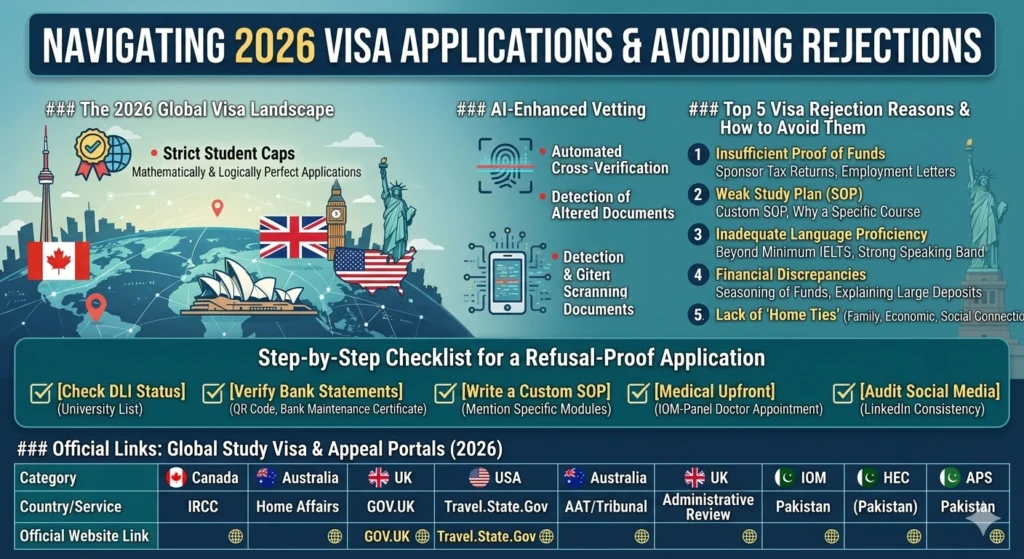
The 2026 Global Visa Landscape
The year 2026 has introduced a “Quality First” era in international immigration. Furthermore, countries like Canada, Australia, and the UK have implemented strict student caps. Indeed, these caps mean that visa officers are looking for reasons to refuse applications rather than approve them. Therefore, your application must be mathematically and logically perfect.
AI-Enhanced Vetting
Specifically, immigration departments now use automated systems to cross-verify your bank statements with tax records. Consequently, “Photoshopped” or altered documents are detected within seconds. This leads to a permanent “Fraud” mark on your biometric profile across the Five Eyes alliance.
Top 5 Visa Rejection Reasons & How to Avoid Them
“Knowledge is the antidote to fear,” as Ralph Waldo Emerson once said. Specifically, you must understand why officers say “No” to stay ahead of the curve.
1. Insufficient Proof of Funds
This is the leading cause of refusal in 2026. Specifically, students often show the required amount but fail to show the source of that money. Pro-Tip: If your father is your sponsor, include his tax returns and a detailed employment letter.
2. Weak Study Plan (Purpose of Visit)
Many applicants use generic templates for their Statement of Purpose (SOP). Your SOP must explain why you chose a specific course over a local one. Failing to do so triggers a “Credibility” red flag.
3. Inadequate Language Proficiency
In 2026, meeting the “minimum” IELTS score is often not enough for high-risk regions. Specifically, if your speaking band is low, the officer will doubt your ability to thrive academically. Indeed, this leads to a refusal under the “Academic Ability” clause.
Financial Discrepancies: The Number One Killer
Above all, the Visa Rejection Reasons & How to Avoid them start with your bank balance. Specifically, you must understand the “Seasoning of Funds” rule.
The “Sudden Deposit” Red Flag
I found that students often borrow money from relatives a week before the application. Specifically, the embassy views this as “Funds for Show.” Consequently, they will refuse the visa. They believe the money will be returned to the relative after the grant.
Currency Volatility
In 2026, the PKR and other emerging currencies remain unstable. Indeed, you should always maintain a 15% buffer above the official requirement. Therefore, if the exchange rate dips on the day of decision, your funds remain “sufficient.”
Proving “Intent to Return”: The Home Ties Factor
“The magic thing about home is that it feels good to leave, and it feels even better to come back.” This sentiment is exactly what a visa officer wants to hear. Specifically, you must prove that you have a life waiting for you after graduation.
- Family Ties: Mention your dependent parents or siblings.
- Economic Ties: Discuss family businesses, inherited property, or a “waiting” job offer.
- Social Ties: Specifically, highlight your involvement in local community organizations.
Step-by-Step Checklist for a Refusal-Proof Application
- Check DLI Status: Ensure your university is on the “Approved” list for 2026.
- Verify Bank Statements: Request a “Bank Maintenance Certificate” with an official QR code.
- Write a Custom SOP: Specifically, mention three specific modules you are excited to study.
- Medical Upfront: Book your medical exam via an IOM-panel doctor before the application.
- Audit Social Media: Indeed, officers now check LinkedIn profiles for consistency with your CV.
Common Mistakes to Avoid
- Hiding Previous Refusals: Specifically, never lie about a past rejection from any country. The “Five Eyes” countries share data.
- Using an Unverified Agent: Some agents submit fake documents without the student’s knowledge. Consequently, the student gets banned for 10 years.
- Inconsistent Academic Gaps: If you have a 2-year gap, you must provide experience letters or certificates.
- Ignoring the CAS/COE Details: Specifically, your visa application must match the dates and fees on your university offer letter exactly.
Frequently Asked Questions (FAQ)
What is the main reason for Canadian student visa rejection in 2026?
The most frequent reason is “Purpose of Visit” combined with the new “Provincial Attestation Letter” (PAL) errors. Specifically, the IRCC wants to ensure you are a genuine student who will leave after your studies.
Can I appeal a visa refusal?
Yes, but it depends on the country. Specifically, the UK allows an “Administrative Review,” while Australia offers an “AAT Appeal.” However, I found that reapplying with better documents is usually faster and more successful.
How do I avoid rejection for “Insufficient Funds”?
Always show a 6-month transaction history. Specifically, explain any large deposits with a “Gift Deed” or “Property Sale” document. Indeed, transparency is your best defense against financial scrutiny.
Does a low IELTS score lead to visa rejection?
Not always, but it increases the risk. Specifically, if you meet the university’s requirement, but you fall below the visa’s “SDS” or “Fast-Track” threshold. Then, your file enters a higher-scrutiny queue.
Why was my visa rejected for “Lack of Home Ties”?
This happens when you fail to show property, family, or employment prospects in your home country. Specifically, the officer believes you intend to stay in the host country illegally after graduation.
What should I do if my visa is rejected?
First, request the “Notes” (like GCMS notes for Canada). Specifically, these notes tell you the exact reason the officer was not satisfied. Then, address those specific concerns in your new application.
Is an education loan a safe way to show funds?
Yes. Specifically, a sanctioned loan from a nationalized bank is considered highly credible. Consequently, it removes the suspicion of “borrowed” funds.
Do visa officers check my social media?
In 2026, many embassies utilize digital vetting. Specifically, they check LinkedIn to see if your work history matches your visa application. Therefore, keep your professional profiles updated and honest.
Can I change my course after a visa rejection?
Yes. If your rejection was due to a “mismatch of profile,” switching to a more relevant course can help. Specifically, explain in your new SOP why the new course is a better fit for your career.
How many times can I apply for a visa after rejection?
There is no legal limit. But I found that after three rejections, your “Risk Profile” becomes very high. Therefore, you must significantly change your circumstances or documents before applying again.
Summary
Navigating Visa Rejection Reasons & How to Avoid Them is about eliminating every possible doubt in the officer’s mind. By focusing on financial transparency, genuine academic intent, and strong home ties, you build an unshakable case. Specifically, treat your visa application as a legal document, not just a formality. Indeed, the extra week you spend verifying your bank statement today can save you a lifetime of regret tomorrow.
Official Links: Global Study Visa & Appeal Portals (2026)
| Category | Country/Service | Official Website Link |
| Visa Application | Canada (IRCC) | canada.ca/en/immigration-refugees-citizenship |
| Visa Application | Australia (Home Affairs) | immi.homeaffairs.gov.au |
| Visa Application | United Kingdom (GOV.UK) | gov.uk/student-visa |
| Visa Application | USA (Travel.State.Gov) | travel.state.gov/student-visas |
| Refusal Appeal | Australia (AAT/Tribunal) | online.aat.gov.au |
| Refusal Review | UK Administrative Review | gov.uk/ask-for-a-visa-administrative-review |
| Medical Exams | IOM Pakistan (Medical) | pakistan.iom.int/appointments |
| Document Attest | HEC (Pakistan) | hec.gov.pk |
| Verification | APS Pakistan (for Germany) | aps.org.pk |

Specifically, Englopak is Pakistan’s premier gateway for international education, career development, and language proficiency. Founded on the principle of bridging the gap between local potential and global excellence, we provide a 360-degree ecosystem for students and professionals aiming for the USA, UK, Germany, Norway, and beyond.
Currently, in an era of complex visa regulations and shifting academic landscapes, Englopak stands as a trusted navigator. Indeed, we don’t just offer consultations; we offer a roadmap. Our expertise spans across high-stakes test preparation (IELTS, PTE, OET), comprehensive study abroad budget planning, and exclusive scholarship mapping tailored for the Pakistani demographic.
Furthermore, we understand that a global journey is more than just an application—it is a life-changing transition. Consequently, we prioritize technical accuracy in document attestation, financial certification, and interview preparation. Ultimately, our mission is to empower every Pakistani student with the tools, language skills, and strategic insights needed to thrive in the world’s most competitive environments.
At Englopak, your global future isn’t just a dream—it’s a plan.
Phone Numbers
- 1. Rawalpindi : 0315 9117529
- 2. Islamabad: 0315 9956772
- 3. Peshawar: 0342 0092051
- Info@englopak.com
- Englopakdigital@gmail.com
- Englopakinstitutes@gmail.com