Introduction
Choosing a study destination is a life-altering decision that requires careful financial and academic planning.
Furthermore, as traditional markets like the UK and Canada tighten their visa regulations, many scholars are looking toward Northern Europe.
Specifically, the prospect of studying in Norway for international students in 2026 has gained massive popularity due to the country’s world-class education system and breathtaking natural beauty.
Indeed, Norway offers a unique blend of high-tech innovation and a serene lifestyle.
Why Choose Norway in 2026?
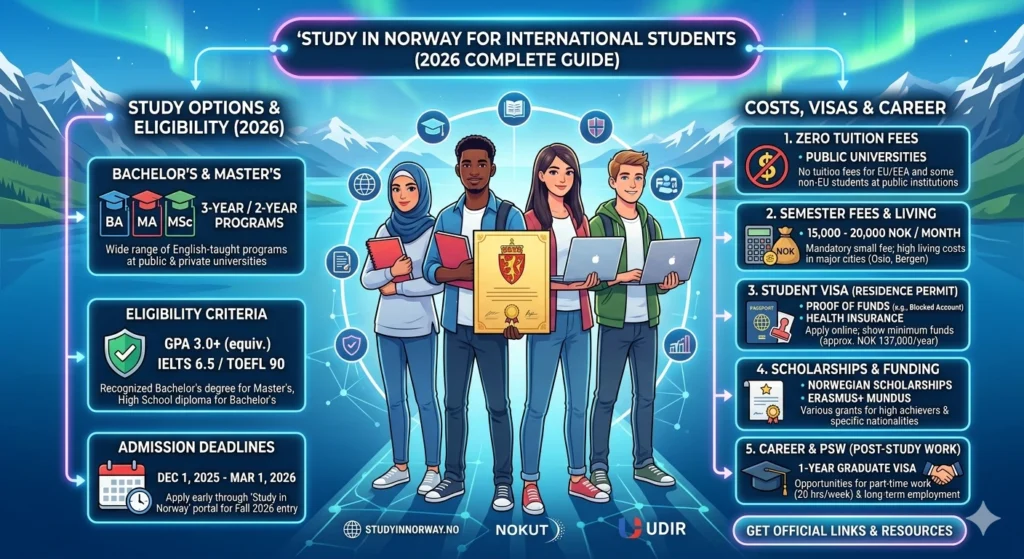
To begin with, Norway is consistently ranked as one of the happiest countries in the world. Consequently, international students often find the transition easier than expected. Moreover, Norwegian universities are at the forefront of research in Renewable Energy, Marine Biology, and Social Sciences.
Specifically, for the 2026 academic year, institutions have expanded their English-taught Master’s programs to attract a more diverse global talent pool. Therefore, if you seek an education that combines theory with practical environmental consciousness, Norway is your ideal destination.
Norway Study Visa Requirements 2026
To clarify, if you are a non-EU/EEA student, you must apply for a “Study Permit.” Indeed, this is a mandatory step before you can step foot in a Norwegian classroom. Specifically, the Norwegian Directorate of Immigration (UDI) has updated its criteria for 2026.
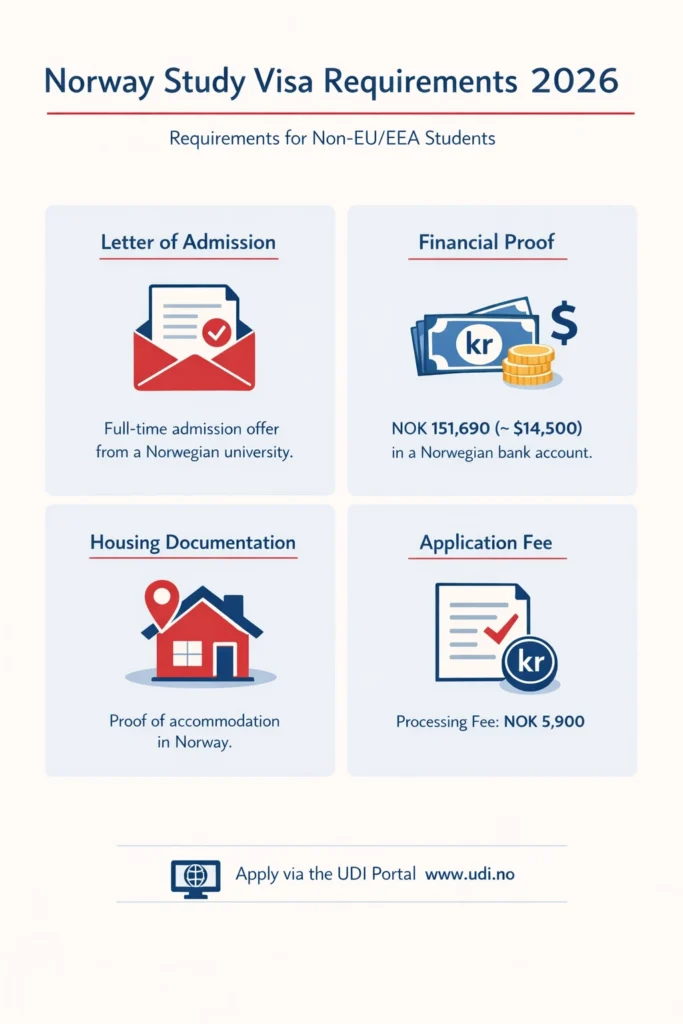
The Mandatory Checklist:
- Letter of Admission: You must have a full-time admission offer from a recognized Norwegian university.
- Financial Proof (Maintenance): Currently, you must document at least NOK 151,690 (approximately $14,500) for one academic year. Consequently, this money must be deposited into a Norwegian bank account or the university’s dedicated deposit account.
- Housing Documentation: Furthermore, you must prove that you have a place to live, such as a student dormitory contract.
- Application Fee: Specifically, you must pay the processing fee (approximately NOK 5,900) via the UDI portal.
The Cost of Living: A Realistic Breakdown
Above all, Norway is known for being expensive. Therefore, you must plan your budget with precision to avoid financial stress. In fact, while some universities offer low tuition, the daily expenses are among the highest in Europe.
| Category | Estimated Monthly Cost (NOK) | Estimated Monthly Cost (USD) |
| Accommodation | 4,500 – 7,500 | $430 – $720 |
| Food & Groceries | 3,000 – 4,000 | $290 – $385 |
| Transport | 500 – 800 | $48 – $77 |
| Miscellaneous | 1,500 – 2,000 | $145 – $190 |
Consequently, a typical student should budget between NOK 10,000 and NOK 14,000 per month. However, you can significantly reduce these costs by cooking at home and using student discounts for public transport.
Language Requirements and IELTS
Similarly to other European hubs, proficiency in English is a non-negotiable requirement for English-taught programs. Specifically, most Master’s programs require an IELTS score of 6.5 or higher.
Nevertheless, some universities may waive this if your previous degree was taught entirely in English. Indeed, we recommend checking the specific “GSU-list” (Higher Education Entrance Qualification) for your home country to see exact requirements.
Part-Time Work Rights in Norway
Fortunately, your study permit allows you to work part-time. Specifically, international students can work up to 20 hours per week during the semester and full-time during holidays. Consequently, this is an excellent way to supplement your budget and gain local work experience.
Moreover, finding a job in the service or tech sector can help you build a network for post-graduation employment.
Top 5 Norwegian Universities for 2026
To begin with, selecting the right institution is just as important as choosing the country. Specifically, Norway’s higher education system consists of public universities, specialized university institutions, and private colleges.
Consequently,international students usually gravitate toward public universities because they offer a wide range of English-taught master’s programs. Furthermore, these institutions maintain high global rankings and strong ties to the Scandinavian job market.
1. University of Oslo (UiO)
Indeed, the University of Oslo is the oldest and highest-ranked university in Norway. Specifically, it excels in social sciences, law, and medicine.
Moreover, the campus is located in the heart of the capital, providing students with immediate access to government agencies and international NGOs. As a result, if you aim for a career in public policy or research, UiO is your primary choice.
2. Norwegian University of Science and Technology (NTNU)
In contrast, if you are an engineering or technology student, NTNU is the best fit. Specifically, it is located in Trondheim and serves as the national hub for innovation. Indeed, NTNU cooperates closely with industry leaders in the energy and maritime sectors.
Consequently, graduates from NTNU often find high-paying jobs in Norway’s oil and gas or renewable energy industries shortly after graduation.
3. University of Bergen (UiB)
Furthermore, the University of Bergen is world-renowned for its marine research and climate studies. Specifically, its location on the west coast makes it a natural laboratory for environmental science.
In addition, UiB offers a very international environment, with students from over 100 countries. Therefore, it is a perfect choice for those who want a globally focused education in a scenic coastal city.
4. University of Tromsø (The Arctic University of Norway)
Similarly, for students interested in Arctic studies, space science, or indigenous culture, UiT offers unique programs found nowhere else. Specifically, it is the northernmost university in the world. Despite its remote location, it provides state-of-the-art facilities and a vibrant student life under the Northern Lights.
5. BI Norwegian Business School
Finally, if you are interested in finance or management, BI is the only triple-accredited business school in Norway. Although it is a private institution and charges tuition fees, it offers numerous scholarships for top-tier international students. Consequently, it remains a top destination for aspiring entrepreneurs and business leaders.
Top Norwegian Universities: Fees & Deadlines (2026/2027)
| University | Estimated Annual Tuition (Non-EU) | Application Deadline (Fall 2026) | Official Website Link |
| 1. University of Oslo (UiO) | NOK 180,000 – 260,000 | Dec 1, 2025 (Non-EU) Mar 1, 2026 (EU) | uio.no/english |
| 2. NTNU (Trondheim) | NOK 150,000 – 250,000 | Dec 1, 2025 (Non-EU) Mar 1, 2026 (EU) | ntnu.edu |
| 3. University of Bergen (UiB) | NOK 160,000 – 240,000 | Dec 1, 2025 (Non-EU) Mar 1, 2026 (EU) | uib.no/en |
| 4. Univ. of Tromsø (UiT) | NOK 130,000 – 200,000 | Dec 1, 2025 (Non-EU) Mar 1, 2026 (EU) | uit.no/english |
| 5. BI Business School | NOK 110,000 – 220,000 | Feb 2, 2026 (Priority) Mar 1, 2026 (Final) | bi.edu |
Post-Study Work Opportunities: The “Job Seeker” Visa
To clarify, many students choose Norway because they want to build a long-term career there. Fortunately, the Norwegian government allows you to stay for up to one year after graduation to find a relevant job.
Specifically, you must apply for a “Residence Permit for Job Seekers” before your current study permit expires.
- Eligibility: You must have completed a master’s or PhD in Norway.
- Financial Requirement: Indeed, you must still prove you have approximately NOK 151,690 to support yourself during this year.
- Active Steps: Therefore, start networking in your final semester. Specifically, use platforms like LinkedIn and the university’s career services to connect with Norwegian employers.
The Complete FAQ Guide
1. Is tuition still free for international students in Norway for 2026?
To clarify, since 2023, most students from outside the EU/EEA and Switzerland must pay tuition fees at public universities. Currently, for the 2026/2027 academic year, fees typically range from NOK 80,000 to NOK 280,000 per year depending on the program.
However, PhD candidates and exchange students through specific programs (like Erasmus+) generally remain exempt from these fees.
2. How much “Proof of Funds” is required for a 2026 Study Permit?
Specifically, to obtain a student residence permit, you must document access to at least NOK 166,859 (approx. $15,500 USD or PKR 4.3 million) for the first academic year. Indeed, this amount covers living costs and must be deposited into a dedicated Norwegian bank account or the university’s holding account before you apply for your visa.
3. What are the application deadlines for the Autumn 2026 intake?
Furthermore, deadlines for non-EU applicants are significantly earlier than for locals. Specifically:
- Non-EU/EEA Applicants: Applications usually open in October 2025 and close between November 15 and December 1, 2025.
- EU/EEA Applicants: Portals typically open in February 2026 and close on March 1, 2026.
4. Can I study in Norway in English without knowing Norwegian?
Indeed. While most Bachelor’s programs are taught in Norwegian, there are an increasing number of English-taught Bachelor’s (like Global Development or Business) and hundreds of Master’s programs available entirely in English.
Consequently, you will need toprovide an IELTS (minimum 6.5) or TOEFL (minimum 90) score to prove your proficiency.
5. Are there scholarships for non-EU students to cover tuition in 2026?
To clarify, while general “free” tuition is gone, many universities have introduced internal merit-based scholarships. Specifically, look for the BI Presidential Scholarship (for business students) or the NORPART and Erasmus Mundus programs. Ultimately, these are highly competitive and require early application (often by January 2026).
6. How many hours can international students work in Norway?
Specifically, your study permit automatically grants you the right to work part-time for up to 20 hours per week during the semester and full-time during university holidays. Indeed, part-time work is a common way for students to offset Norway’s high cost of living.
7. What is the “Semester Fee” and do I have to pay it?
Indeed. Every student, regardless of tuition status, must pay a small Semester Fee (approx. NOK 600–1,000). Consequently, this fee grants you membership in the Student Welfare Organization (Samskipnaden), providing discounts on healthcare, housing, and sports facilities.
8. Is it easy to find student housing in major cities like Oslo or Bergen?
Currently, housing is in high demand. Therefore, you should apply for student housing through the local Samskipnad as soon as you receive your admission letter. Ultimately, university-managed housing is significantly cheaper and more secure than the private rental market.
9. What is the “Post-Study Work Visa” for Norway in 2026?
Fortunately, after graduating from a Norwegian university, you can apply for a job-seeker visa (residence permit for stay after completing studies), which allows you to stay in Norway for up to one year to look for relevant employment.
10. Do I need a blocked account like in Germany?
To clarify, Norway does not use a “blocked account” in the exact same way Germany does. Indeed, you transfer the required funds to a deposit account managed by your university. Once you arrive in Norway and open a personal bank account, the university transfers the full amount back to you.
Official 2026 Resources
- Study in Norway (Official Portal): The primary source for program searches and fee info.
- UDI (Norwegian Directorate of Immigration): Ultimately, the only official site for visa and residence permit applications.
- NOKUT: The authority for the recognition of foreign education credentials.
Quick Tips for Applicants
- Early Bird Advantage: Indeed, public universities in Norway have very early deadlines (often December of the previous year). If you are reading this in early 2026, you should focus on the 2027 intake or check BI’s remaining spots.
- Document Verification: Specifically for Pakistani students, Norway requires your degrees to be verified by HEC and MOFA. Start this process at least 3 months before the deadline.
- English Proficiency: Most Master’s programs require an IELTS score of 6.5 or higher. Consequently, book your test slot early, as centers in major cities like Lahore and Karachi fill up fast during peak application months.

Englopak is Pakistan’s premier gateway for international education, career development, and language proficiency. Founded on the principle of bridging the gap between local potential and global excellence, we provide a 360-degree ecosystem for students and professionals aiming for the USA, UK, Germany, Norway, and beyond.
Furthermore, we understand that a global journey is more than just an application—it is a life-changing transition. Consequently, we prioritize technical accuracy in document attestation, financial certification, and interview preparation.
At Englopak, your global future isn’t just a dream—it’s a plan.
Phone Numbers
1. Rawalpindi : 0315 9117529
2. Islamabad: 0315 9956772
3. Peshawar: 0342 0092051
Info@englopak.com
Englopakdigital@gmail.com
Englopakinstitutes@gmail.com