Your Golden Ticket: Navigating the Letter of Acceptance (LOA)
So, you’ve spent weeks (maybe months) polishing your personal statement, chasing down professors for recommendations, and refreshing your email every ten minutes. Then, it happens: an email arrives with a subject line that makes your heart skip a beat. You open the attachment, and there it is—your Letter of Acceptance (LOA). This isn’t just a piece of paper; it’s the official bridge between your current life and your future as an international student.
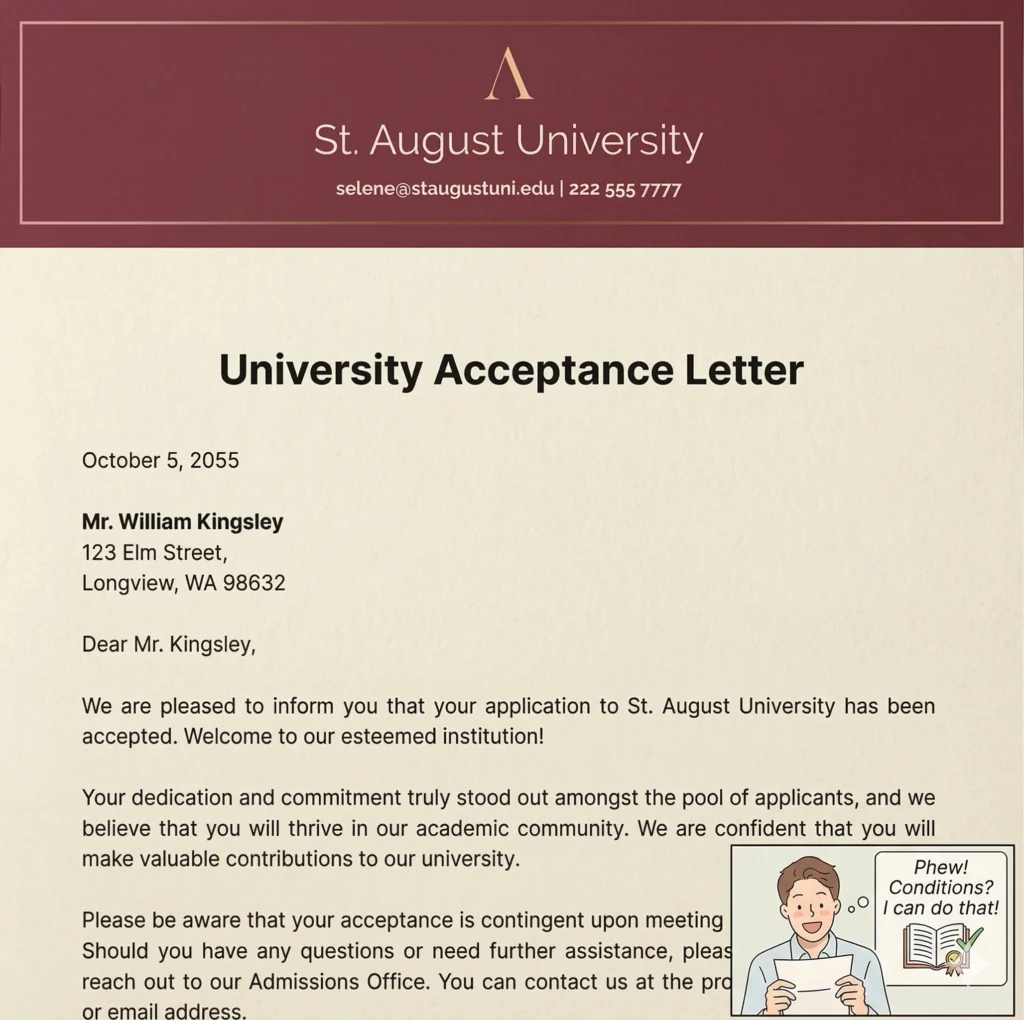
What Exactly is a Letter of Acceptance? (The Quick Version)
In simple terms, a Letter of Acceptance is a formal document issued by a college or university confirming that you have been offered a spot in a specific program. It serves as your “proof of admission” and is the most critical document you’ll need to apply for a student visa or study permit. Without this letter, your study abroad journey stays stuck at the starting line.
Why the LOA is a Big Deal
Beyond the obvious “Yay, I got in!” factor, the LOA is a legal and administrative powerhouse. Think of it as your academic passport.
- Visa Processing: Immigration officers won’t even look at your visa application without an official LOA from a Designated Learning Institution (DLI).
- Financial Planning: It outlines your tuition fees, start dates, and any scholarships you’ve won, which helps you prove you can afford the move.
- Housing & Enrollment: Most universities won’t let you apply for on-campus dorms until you have your formal acceptance in hand.
Breaking Down the Details: What’s Inside?
Every university has its own style, but a standard, professional LOA should always include:
- Your Full Name and Address: Exactly as it appears on your passport.
- Student ID Number: Your unique “identity” at that school.
- The Program Name: For example, B.Sc. in Renewable Energy Engineering.
- The Start and End Dates: When you need to be on campus and when you’re expected to graduate.
- Conditions (The Fine Print): Sometimes, an offer is “Conditional.” This means you’re in if you finish your current degree with a certain GPA or pass an English test like the IELTS.
- Tuition Fees: A breakdown of what you owe for the first year.
Step-by-Step: What to Do After You Get Your Letter
Receiving the letter is the finish line of the application, but it’s the starting line of the relocation process. Here’s your game plan:
Step 1: Check for Accuracy Check every single letter of your name. If your name is “Jonathan” and the letter says “Johnathan,” it could cause massive headaches at the visa office. If there’s an error, email the admissions office immediately.
Step 2: Read the Conditions. Is it a Full Offer or a Conditional Offer? If it’s conditional, make sure you know exactly what documents you still need to send and by what deadline.
Step 3: Accept the Offer Just because they sent it doesn’t mean you’re enrolled. You usually have to “accept” the offer through an online portal. This often requires a Tuition Deposit—a down payment to hold your seat.
Step 4: Start the Visa Process As soon as you have the “Final” or “Unconditional” letter, head straight to the embassy website. Time is of the essence!
FAQs: Common Questions from Future Global Students
Q: Can I use an email printout as a Letter of Acceptance? A: Usually, yes, provided it is an official PDF attachment on the university’s letterhead. A plain text email saying “Congrats, you’re in!” won’t work for visa purposes.
Q: What is the difference between an Offer Letter and a Letter of acceptance? A: Often, they are used interchangeably. However, in some countries (like Canada or Australia), an “Offer Letter” is an invitation to join, while the “Letter of Acceptance” is the final document issued after you pay your deposit.
Q: Can a university withdraw my letter of acceptance? A: Technically, yes—but only if you fail to meet the conditions (like failing your final exams) or if they find out you submitted fraudulent documents. Stay honest and keep those grades up!
Q: I got accepted to three schools! Which LOA do I use? A: Only use the LOA for the school you actually intend to attend. If you apply for a visa with School A’s letter but try to show up at School B, you might find yourself on a very long flight back home.
Congratulations on this huge milestone! You’ve done the hard work—now it’s time to pack your bags.

Englopak is Pakistan’s premier gateway for international education, career development, and language proficiency. Founded on the principle of bridging the gap between local potential and global excellence, we provide a 360-degree ecosystem for students and professionals aiming for the USA, UK, Germany, Norway, and beyond.
Furthermore, we understand that a global journey is more than just an application—it is a life-changing transition. Consequently, we prioritize technical accuracy in document attestation, financial certification, and interview preparation.
At Englopak, your global future isn’t just a dream—it’s a plan.
Phone Numbers
1. Rawalpindi : 0315 9117529
2. Islamabad: 0315 9956772
3. Peshawar: 0342 0092051
Info@englopak.com
Englopakdigital@gmail.com
Englopakinstitutes@gmail.com