Quick Outlines
- Study abroad budget planning students
- Study abroad cost comparison students
- Monthly expenses abroad students
- Germany blocked account cost students
- UK student visa financial requirements
- Cheapest countries for students study abroad
Study abroad budget planning for students has become essential in 2026 due to rising global inflation and currency fluctuations.
Pakistani students planning to study in the UK, Canada, Australia, or Germany must carefully calculate tuition fees, visa costs, and living expenses before applying.
Currently, the financial landscape has changed. Canada doubled its cost-of-living requirements. The UK also updated its health surcharges.
Consequently, without a detailed “rupee-to-reality” budget, even the most brilliant students risk facing visa rejections or mid-semester financial crises.
How Much Study Abroad Budget
Pre-Departure Costs in
Securing a seat at a global university starts with a sharp pencil and a solid budget. Specifically, the pre-departure phase in Pakistan requires a front-loaded investment of approximately PKR 600,000 to 1,200,000. Currently, this covers mandatory IELTS for UKVI or PTE fees (approx. PKR 72,000), university application charges, and health examinations. Furthermore, visa fees have surged across the board. Consequently, you must account for these non-refundable expenses before even considering your tuition deposit.
Meeting New Financial Requirements
Demonstrating financial capacity is the most critical hurdle for your visa approval. Specifically, global authorities have raised the “Proof of Funds” bar significantly for 2026. Currently, the UK requires you to show at least £1,529 per month for London-based studies, while Canada demands a GIC investment of CAD 20,635 (approx. PKR 4.2 Million). Moreover, Germany’s blocked account requirement now stands at €11,904. Therefore, your bank statement must reflect these updated figures to avoid a sudden rejection.
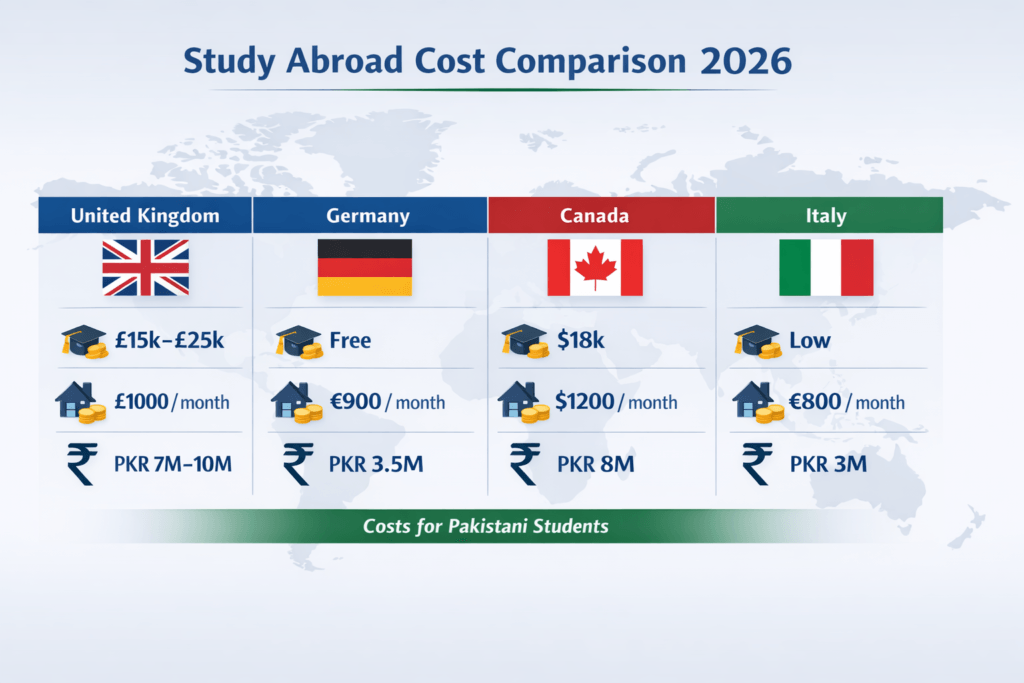
Comparing Global Education Costs
Tuition fees remain the largest single expense on your balance sheet. Specifically, a one-year Master’s in the UK or Australia can range from PKR 5.5 million to 9.5 million. Currently, many universities offer early-bird discounts or Lester B. Pearson style scholarships to ease this burden. However, science and engineering programs usually sit at the higher end of the pricing scale.
Managing Living Expenses Abroad
Managing daily life abroad requires a disciplined monthly spending plan. Specifically, rent and groceries will consume the bulk of your income. Currently, a shared room in a major Western city cost between PKR 150,000 and 220,000 per month. Moreover, transition devices like student rail cards and budget supermarket apps are essential for survival. Therefore, while part-time work can help, you should never rely on it to pay your main tuition fees.
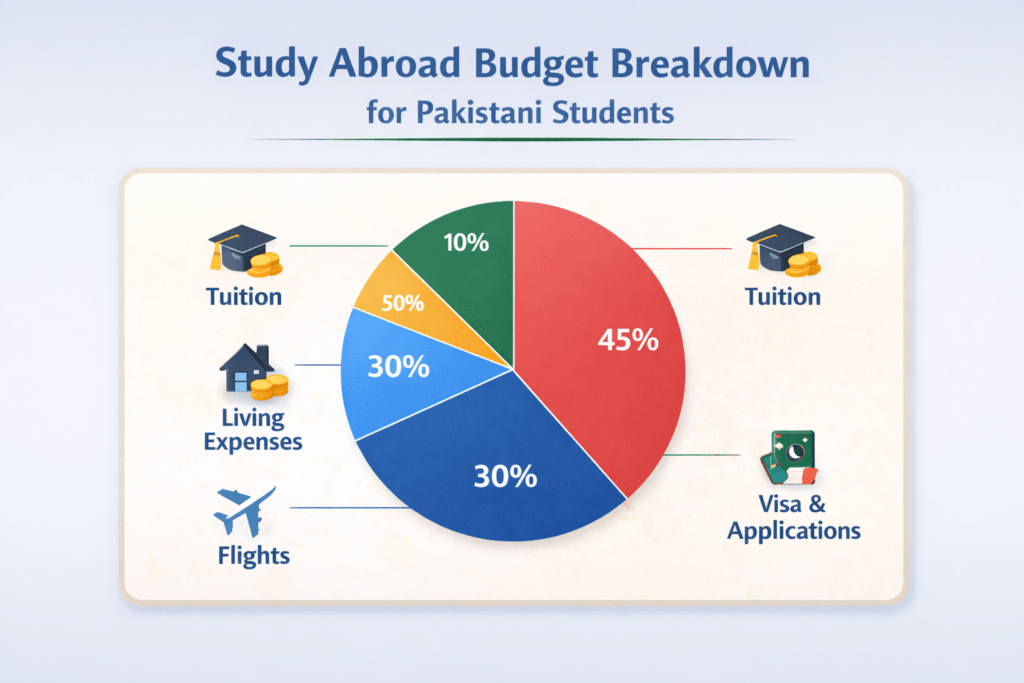
If Europe feels too competitive, Malaysia and China offer the most predictable low-cost pathways. Specifically, annual tuition in Malaysia averages between $3,000 and $6,000 (approx. PKR 850k – 1.6M), with living costs significantly lower than in the West. Furthermore, China’s CSC Scholarship often covers tuition, housing, and a monthly stipend, making it a “net-zero” budget option for top-tier students. Ultimately, these regions allow you to maintain a high standard of education without the massive “show money” requirements seen in the UK or Australia.
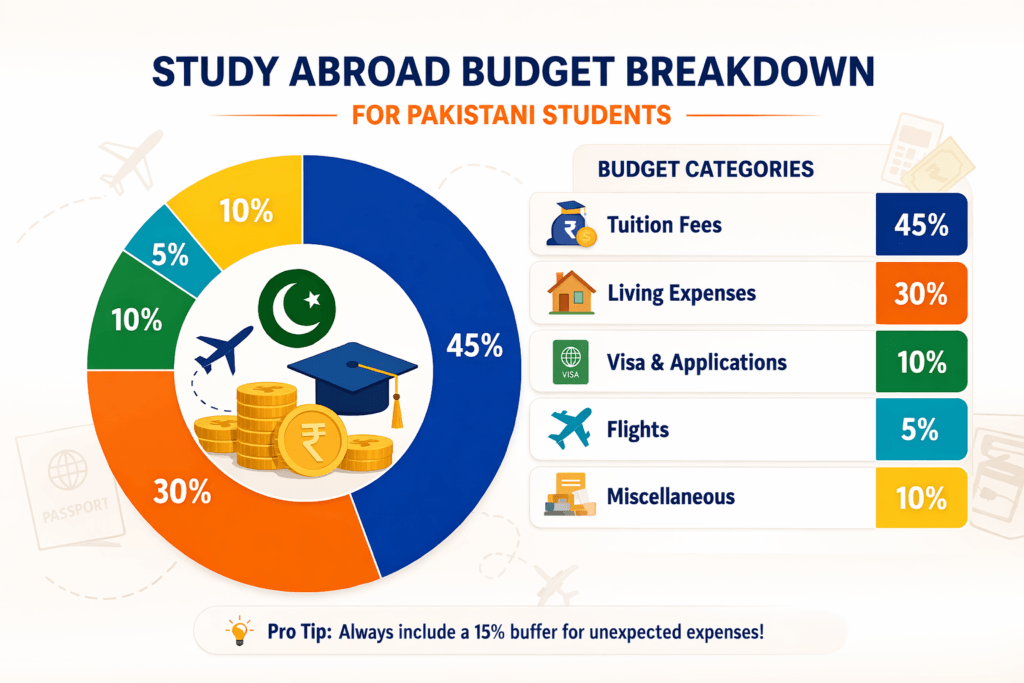
Smart budgeting continues even after you secure your visa and arrive at your destination. Specifically, you should leverage your 20-hour weekly work rights to cover your food and transport bills. Currently, many students in the UK or Canada survive by sharing rooms and cooking at home, keeping their monthly drain below PKR 150,000. Moreover, always use official remittance channels to move money from Pakistan to avoid legal hurdles.
Monthly Expenses Abroad for Students
Managing your monthly drain is the secret to a stress-free degree. Specifically, for Pakistani students in 2026, the biggest financial shock is often the monthly rent and grocery bill when converted back to PKR. Currently, you should expect to spend between PKR 150,000 and 450,000 per month depending on your city and lifestyle.
Furthermore, student discount cards and loyalty apps are essential for keeping these costs manageable. Therefore, understanding the local price of bread, bus fares, and heating is vital before you land. Rent will be your most significant monthly commitment, often swallowing 50% of your budget. Specifically, a shared room in a city like Manchester or Adelaide costs around PKR 140,000 to 190,000, while London or Sydney can easily double that.
Currently, students save money by choosing “University Halls” which often include heating, water, and high-speed internet in the price. Moreover, living in a “Commuter Town” outside the main city center can drop your rent by 20%, though you must then factor in the cost of a train pass. Food and transport are the next major hurdles for your monthly wallet. Specifically, cooking at home is a survival skill that can save you nearly PKR 80,000 monthly. Currently, grocery shopping at budget supermarkets like Aldi (UK/Germany) or No Frills (Canada) keeps your bill around PKR 60,000.
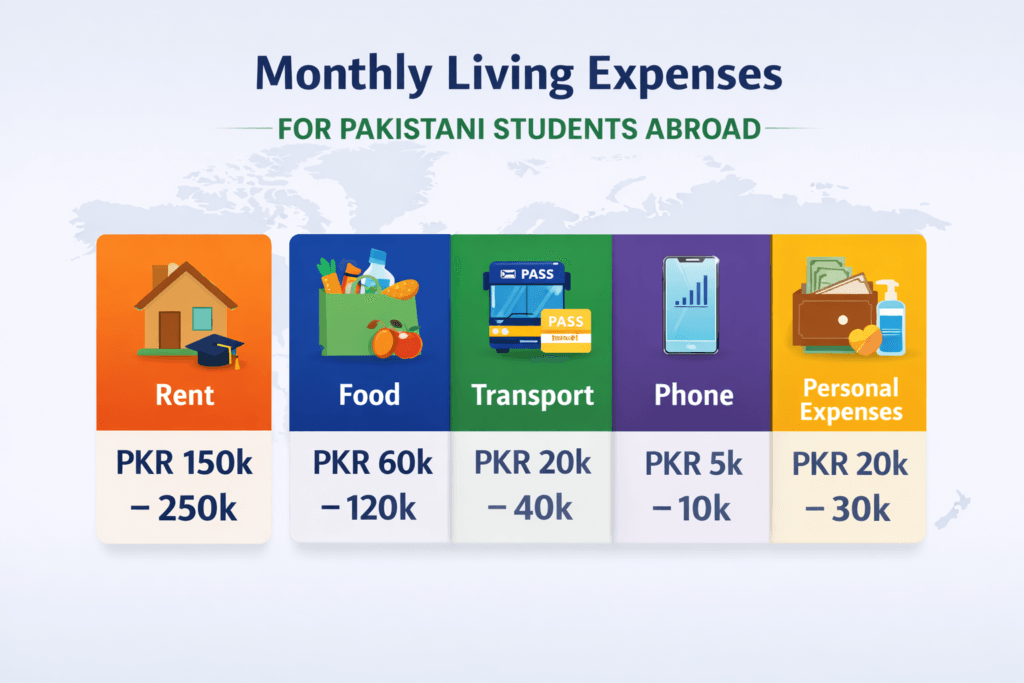
In contrast, eating out just twice a week can inflate your food budget to over PKR 120,000. Furthermore, always buy a Student Railcard or a monthly bus pass; these simple steps can reduce your transport costs by 30% or more.
Finally, do not overlook the “invisible” monthly costs like mobile plans and personal care. Specifically, a standard 5G SIM plan cost about PKR 5,000 to 10,000, while personal items and occasional leisure add another PKR 25,000. Currently, international students are also mindful of the Immigration Health Surcharge or private health insurance, which effectively adds a monthly cost of PKR 20,000 to 30,000 over the year.
Study Abroad Budget for Germany
Germany remains the ultimate “budget king” for students because public universities do not charge tuition. Specifically,in 2026, your main financial hurdle is proving you can afford to live there. Currently, the German government requires a Blocked Account (Sperrkonto) containing €11,904 (approx. PKR 3.8 million). Furthermore, this money is not a “fee” but a deposit; the bank releases €992 back to you every month to cover your rent and food. Therefore, while the upfront cost seems high, the “net cost” of the degree is incredibly low compared to the UK or USA.
Your university costs are mostly limited to a “Semester Contribution” rather than tuition. Specifically, you will pay between €150 and €450 (PKR 45,000 – 135,000) twice a year. Currently, this fee is a bargain because it usually includes a “Semester Ticket” for unlimited bus and train travel in your region. Moreover, some states like Baden-Württemberg may charge non-EU students a tuition fee of €1,500 per semester. Consequently, you should target universities in Berlin, Munich, or North Rhine-Westphalia to keep your tuition costs at absolute zero.
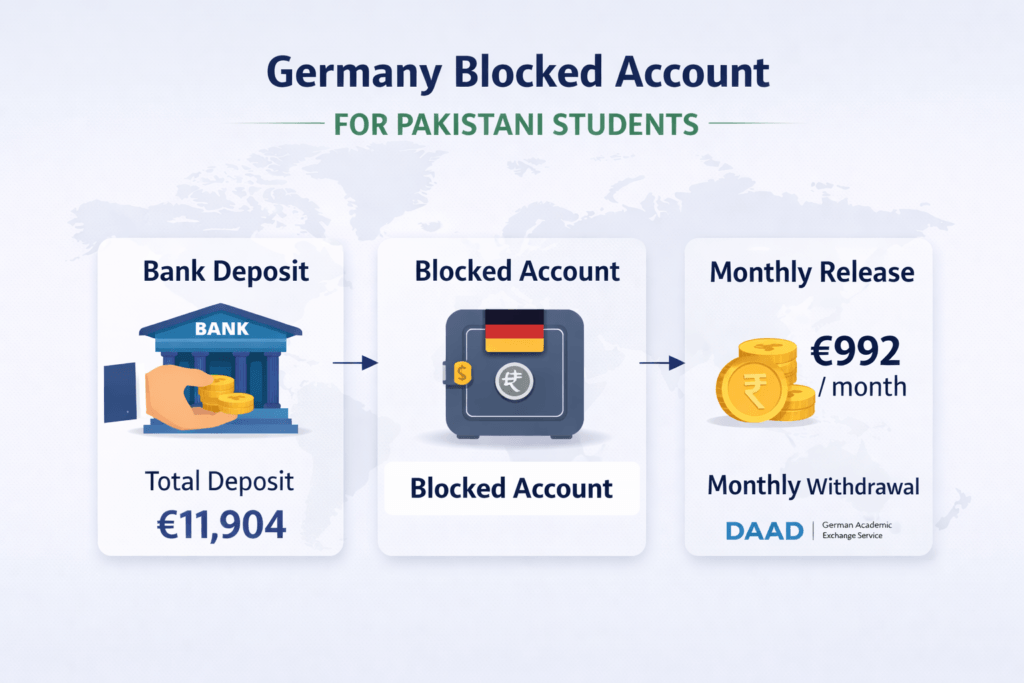
Living expenses in Germany are manageable if you choose your city wisely. Specifically, a monthly budget of €900 to €1,200 (PKR 270,000 – 360,000) is the standard for 2026. Currently, rent in a Student Dorm (Studentenwerk) is the cheapest option, costing around €300, while a private shared flat (WG) can reach €600. Furthermore, health insurance is mandatory and costs about €125 per month for students under 30. Therefore, staying in smaller “University Towns” like Jena or Magdeburg can save you nearly PKR 100,000 every month compared to Munich.
The visa process itself carries a few essential “start-ups” costs you must budget for in Pakistan. Specifically, the National Student Visa fee is €75 (approx. PKR 25,000), plus a VFS service fee of about PKR 12,000. Currently, you must also account for the APS Certificate fee (approx. €100) and translation costs for your educational documents.
Moreover, you can offset these expenses by working part-time for up to 140 full days per year.
Study Abroad Budget for UK
A British degree remains a top choice for Pakistani students due to the one-year Master’s option and strong global reputation. Specifically, in 2026, the initial investment for the UK is “front-loaded,” meaning you must pay a significant portion of your fees and health costs before you leave. Currently, the UK Student Visa application fee is £524 (approx. PKR 185,000).
Furthermore, you must pay the mandatory Immigration Health Surcharge (IHS) upfront, which is £776 per year (approx. PKR 275,000). Therefore, your visa and health insurance alone require nearly PKR 460,000 before you even book your flight. Tuition fees for international students have seen a steady increase, but they vary widely depending on the university’s ranking and location. Specifically, for 2026 entry, a standard master’s degree costs between £15,000 and £25,000 (PKR 5.3M – 8.8M). Currently, many Pakistani students target “affordable” universities like the University of Chester or Hull, where fees can be closer to £14,000.
Moreover, most universities require a tuition deposit of £2,000 to £5,000 to issue your CAS (Confirmation of Acceptance for Studies). Consequently, you should have at least PKR 1.5 Million ready just to secure your seat and begin the visa process.
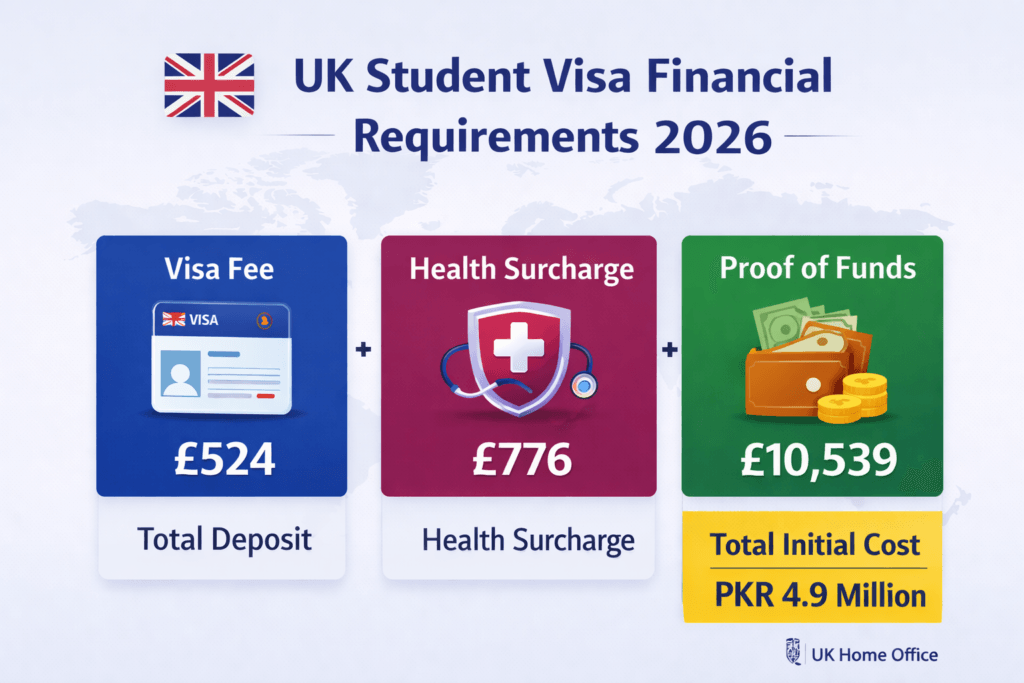
The “Proof of Funds” is the most rigorous part of the UK application, requiring a 28-day bank statement. Specifically, as of 2026, you must show you can cover your remaining tuition plus living expenses for nine months. Currently, the living cost requirement is £1,529/month for London and £1,171/month for outside London. For a student heading to Manchester or Birmingham, this means showing roughly £10,539 (approx. PKR 3.7 million) in a bank account. Therefore, if your remaining tuition is £10,000, your total “show money” would be nearly PKR 7.2 million.
Daily life in the UK is expensive, but strategic habits can make it manageable for a Pakistani student budget. Specifically, rent for a shared room averages PKR 140,000 to 200,000 per month, while groceries at stores like Aldi or Lidl cost about PKR 60,000. Currently, students maximize their budget by working the legal 20 hours per week, which can bring in roughly £800 – £1,000 (PKR 280k – 350k) per month. Moreover, using a 16-25 Railcard can save you 30% on all train travel across the country.
Canada Study Abroad Budget
Canada remains a top-tier destination for Pakistani students in 2026, offering a direct route to permanent residency, though it requires a significant “GIC” deposit upfront. Specifically, for a study permit application, you must now provide a Guaranteed Investment Certificate (GIC) of CAD 20,635 (approx. PKR 4.3 Million) to cover your first year’s living expenses. Currently, this amount is locked in a Canadian bank and released to you in monthly installments once you arrive. Consequently, between the GIC, the study permit fee of CAD 150, and the biometrics fee of CAD 85, your initial “living cost” savings must be ready before you even book your flight.
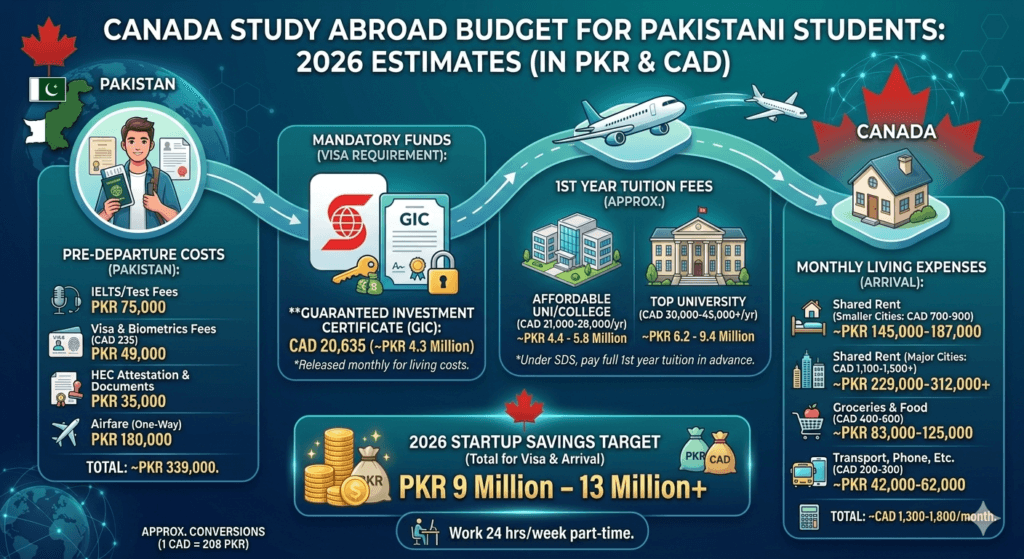
Tuition fees for international students in Canada have been adjusted for 2026 entry to reflect the new International Student Cap. Specifically, a Master’s degree averages between CAD 21,000 and CAD 35,000 (PKR 4.5M – 7.5M) per year, while undergraduate programs can reach CAD 40,000. Furthermore, if you apply under the Student Direct Stream (SDS) or its 2026 equivalent, you are typically required to pay the full first-year tuition fee in advance. Therefore, a Pakistani student should have a total starting budget of roughly PKR 9 Million to 12 Million to safely cover tuition, the GIC, and travel.
Daily life in Canada is manageable if you choose your city strategically. Specifically, while rent in Toronto or Vancouver can exceed CAD 1,500/month, smaller cities like Saskatoon, Winnipeg, or Halifax offer shared housing for around CAD 700–900. Currently, students are permitted to work 24 hours per week during semesters, which can earn you roughly CAD 1,400 – 1,800 monthly—enough to supplement your GIC payments for a comfortable lifestyle.
Australia Study Abroad Budget
Australia remains a top-tier choice for Pakistani students in 2026, offering a blend of world-class education and high earning potential, though the entry requirements have become stricter. Specifically, the Australian Government has increased the “Proof of Funds” requirement for the Student Visa (Subclass 500) to AUD 29,710 (approx. PKR 5.5 Million) for living expenses alone. Currently, the visa application fee itself has seen a major jump to AUD 1,600 (approx. PKR 295,000). Consequently, between the visa fee, mandatory Overseas Student Health Cover (OSHC) of AUD 600–800, and travel costs, you need roughly PKR 6 Million in liquid savings before even considering your tuition fees.
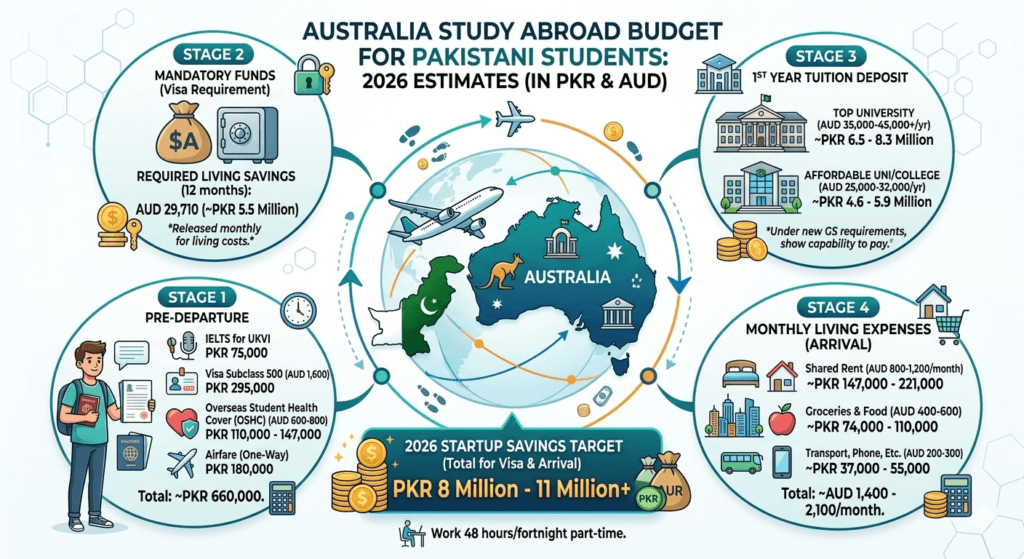
Tuition costs in Australia for 2026 vary significantly based on your field and the university’s prestige. Specifically, a Master’s or Bachelor’s degree typically costs between AUD 25,000 and AUD 45,000 (PKR 4.6M – 8.3M) per year. Furthermore, unlike some European countries, you must pay your first semester’s tuition upfront to receive your Confirmation of Enrolment (CoE). Therefore, a Pakistani student should ideally have a total initial budget (tuition deposit + visa + living funds) of PKR 8 Million to 11 Million to meet the new Genuine Student (GS) requirement, which replaces the old GTE.
While the upfront cost is high, Australia’s minimum wage is among the highest in the world, providing a strong safety net. Specifically, in 2026, students can work 48 hours per fortnight, with a minimum wage of approximately AUD 24.80 per hour. Currently, this allows you to earn roughly AUD 1,900 – 2,400 per month, which is enough to cover your rent in a shared apartment (AUD 800–1,200) and groceries in most cities.
Affordable Study Abroad Option
If the high costs of the UK or USA feel out of reach, several high-value alternatives provide world-class education for a fraction of the price. Specifically, for Pakistani students in 2026, countries like Italy, Germany, and China offer the most realistic pathways to a global degree without a massive financial burden. Currently, these destinations balance low (or zero) tuition with manageable living costs. Furthermore, many of them offer generous scholarships that can turn your study abroad dream into a fully funded reality.
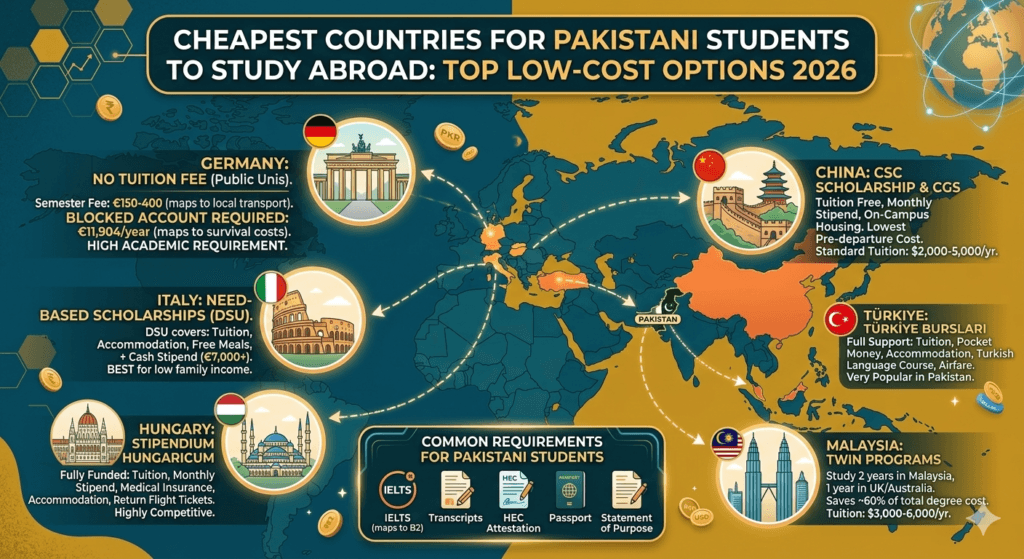
Italy is arguably the most affordable destination due to its unique “Need-Based” scholarship system. Specifically, the DSU Scholarship is awarded based on your family’s income in Pakistan rather than just academic grades. Currently, if your family income is below $25,000 per year, you can receive free tuition, one free meal a day, and a cash stipend of up to €7,000.
Consequently, a Pakistani student can complete a Master’s in Milan or Florence while spending very little of their own money. Therefore, Italy should be the top choice for students with strong profiles but limited bank balances. Germany and Norway remain iconic for their “Free Education” policy at public universities. Specifically, in Germany, you only pay a small “Semester Contribution” of about €150–€400, which often includes a free regional transport pass. However, you must still provide a Blocked Account of €11,904 to cover your own living expenses.
Moreover, countries like Turkey and Hungary offer the Türkiye Bursları and Stipendium Hungaricum scholarships. These programs are highly popular in Pakistan because they cover everything: tuition, monthly pocket money, and even your return flight tickets. For those looking toward Asia, China and Malaysia provide excellent quality with a much lower “cultural shock” and lower price tag. Specifically, annual tuition in China starts as low as $2,000 (PKR 560k), and the Chinese Government Scholarship (CSC) is widely available to Pakistani applicants.
Currently, Malaysia is a hub for “Twin Programs,” where you can study for two years in Kuala Lumpur and one year in the UK, saving 60% of the total cost.
How Much Savings to Study Abroad
To study abroad in 2026, your “savings” aren’t just for your ticket; they are the legal proof required to enter a country. Specifically, you need two types of savings: liquid cash for immediate expenses and “show money” for your visa. Currently, for a Pakistani student, the minimum total savings recommended ranges from PKR 5 Million to 10 Million for premium destinations. Ultimately, having a 15% buffer above the official requirement is the best way to handle the PKR’s volatility.

1. The “Show Money” Breakdown (Visa Requirements)
Embassies require you to prove you have these funds before they stamp your visa. Specifically, in 2026, the benchmarks have risen due to global inflation.
| Destination | Required Savings (Living Only) | PKR Equivalent (Approx) |
| UK (Outside London) | £10,539 (held for 28 days) | PKR 3.9 Million |
| Canada (GIC) | CAD 20,635 (upfront deposit) | PKR 4.3 Million |
| Germany (Blocked A/C) | €11,904 (yearly deposit) | PKR 3.6 Million |
| Australia | AUD 29,710 (yearly requirement) | PKR 5.5 Million |
Furthermore, you must add your remaining first-year tuition fee to the numbers above. Consequently, if your UK tuition is £15,000 and you paid a £5,000 deposit, you need an additional £10,000 (PKR 3.5M) in savings to show the embassy.
2. The “Startup Kit” Savings (The First 30 Days)
Your bank statement covers your future, but your “Startup Kit” covers your arrival. Specifically, you need about PKR 800,000 to 1.2 Million in accessible savings for:
- Flight Tickets: One-way flights from Pakistan currently cost PKR 150,000 – 250,000.
- Security Deposit: Most landlords abroad require 1–2 months of rent upfront.
- Initial Groceries & Winter Gear: Essential if you’re landing in a cold climate.
- Health Surcharge: The UK IHS fee is a one-time upfront cost of £776 (PKR 275k) per year.
3. The “Rupee-to-Reality” Strategy
- Savings in PKR are risky because the exchange rate changes daily. Specifically:
- Sponsorship: If using a sponsor’s account, ensure the source of funds (salary, property sale, or business income) is clearly documented.
Don’t wait: Buy your foreign currency in small batches (tranches) whenever the rate is stable. - Emergency Fund: Keep PKR 300,000 in a Pakistani account that your parents can access in case of an emergency back home.
Study Abroad Budget Tips
Navigating the global financial landscape in 2026 requires more than just saving; it requires a strategic approach to currency and local living. Specifically, for Pakistani students, the goal is to protect your family’s savings from PKR devaluation while maximizing your quality of life abroad. Currently, these ten tips are the most effective ways to stretch your budget.
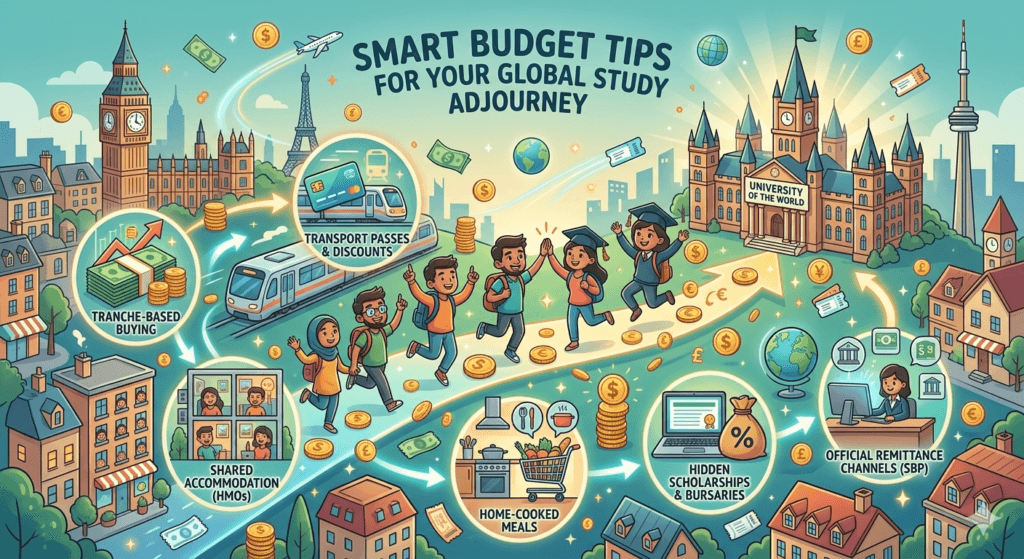
1. Use “Tranche-Based” Currency Buying
Don’t wait until the day of your flight to buy all your foreign currency. Specifically, the PKR can be volatile. Instead, buy small amounts of USD, GBP, or EUR every month leading up to your departure. Consequently, you average out the exchange rate and avoid the “last-minute spike” that can cost you lakhs of rupees.
2. Opt for “Tier 2” Cities
London, Sydney, and Toronto are iconic but incredibly expensive. Specifically, moving to a city like Sheffield (UK), Adelaide (Australia), or Leipzig (Germany) can drop your monthly rent by 30-40%. Furthermore, the cost of a coffee or a bus ticket is significantly lower, while the quality of education remains world-class.
3. Lock the Rate with a Forex Card
Avoid using your Pakistani debit card for daily spending abroad. Specifically, Pakistani cards often charge 3.5% to 5% in foreign transaction fees and “bank-defined” exchange rates. Instead, use a Prepaid Forex Card or a digital wallet like Wise. Ultimately, you lock in a specific rate and pay zero transaction fees on every swipe.
4. Master the “20-Hour” Income Strategy
In 2026, most countries allow you to work 20-24 hours per week. Specifically:
- Australia: Minimum wage is high (~AUD 24.80/hr).
- UK: Minimum wage is ~£11.44/hr. Significantly, if you maximize these hours, you can earn between PKR 300,000 and 450,000 monthly. Therefore, your goal should be to cover 100% of your living costs through work, keeping your savings strictly for tuition.
5. Apply for the “Hidden” Scholarships
Don’t just look for 100% scholarships; look for “Bursaries.” Specifically, many UK and Canadian universities offer automatic £2,000 – £5,000 “Early Bird” or “South Asia Region” discounts. Moreover, programs like Stipendium Hungaricum or DSU Italy offer free meals and housing—benefits that are often worth more than a tuition discount.
6. Use Official Remittance Channels
Always pay your fees through the State Bank of Pakistan’s official routes. Specifically, using “Hundi” or unofficial money changers is risky and can lead to visa rejections. Furthermore, official bank transfers create a “Clean Financial Trail” which is essential if you plan to apply for a post-study work visa or permanent residency later.
7. Buy a “Pre-Departure” Tech Kit
Laptops and gadgets are often cheaper in Pakistan than in Europe or the UK. Specifically, buy your high-end laptop, extra chargers, and power banks in Karachi or Lahore before you leave. In contrast, buying the same tech in London or Berlin will include high VAT (Value Added Tax) of 19% to 20%.
8. Leverage Student “Concession” Passes
Transportation can eat up 15% of your budget. Specifically, never pay full price for a bus or train. Currently, the 16-25 Railcard (UK) or the Semester Ticket (Germany) can save you hundreds of Euros. Moreover, use apps like Too Good To Go to buy unsold restaurant food at 70% discounts at the end of the day.
9. Share Accommodation Strategically
Rent is your biggest enemy. Specifically, avoid “Single Studios.” Instead, look for “HMOs” (Houses in Multiple Occupation) where you share a kitchen but have your own room. Consequently, you split the heating and internet bills with 3-4 other students, saving nearly PKR 50,000 monthly.
10. Join Local Pakistani Student Groups
Networking is a financial tool. Specifically, join Facebook or WhatsApp groups for Pakistani students in your target city. Currently, senior students often sell their furniture, winter coats, and textbooks to juniors for very low prices. Ultimately, this “community recycling” can save you the PKR 100,000 you would have spent on new household items.
Conclusion: From Planning to Departure
In 2026, studying abroad is a significant financial undertaking, but it remains one of the most rewarding investments a Pakistani student can make. Specifically, the secret to success lies in early preparation and a clear understanding of “Total Landed Cost.” Currently, while the PKR remains volatile, using official remittance channels and targeting countries with low tuition can make this dream accessible. Ultimately, if you treat your budget as a living document and stay disciplined with your monthly spending, you can focus on what truly matters: your education and future career.
Frequently Asked Questions (FAQs)
What is the absolute minimum budget for a Pakistani student to study abroad in 2026?
Specifically, for tuition-free countries like Germany or scholarship-heavy destinations like Italy, you need a minimum of PKR 1 million to 1.5 million for pre-departure costs (IELTS, visa, flights, and initial deposits). However, you must still show “Proof of Funds” (around PKR 3.5M – 4.5M) in a bank account, even if you don’t spend it all at once.
Can I rely on part-time work to pay my tuition fees?
No. Specifically, part-time work in 2026 is designed to cover your living expenses (rent, food, and transport). Currently, most countries limit students to 20–24 hours per week, which usually earns enough to survive but not enough to pay thousands of dollars in tuition. Therefore, you should have your tuition fees secured before you leave Pakistan.
Which bank in Pakistan is best for sending university fees?
Major commercial banks like HBL, UBL, and Meezan Bank have dedicated “Foreign Exchange” desks for student remittances. Specifically, you can remit up to $70,000 per year through official channels like UBL’s Education Remittance. Furthermore, using official banks ensures your financial trail is clean for future visa renewals.
How do I protect my budget from the falling value of the Rupee?
The best strategy is to “Buy in Tranches.” Instead of waiting for the last minute, convert your PKR into USD or EUR in small amounts whenever the rate is stable. Moreover, consider using a multi-currency forex card to lock in the exchange rate before you travel.
Are there any hidden costs I should watch out for?
Yes. Specifically, do not forget the UK’s Immigration Health Surcharge (IHS), which is a mandatory PKR 280,000+ upfront payment. In addition, always budget for a “Settling-In Fund” of about PKR 300,000 for your first month’s rent deposit and winter clothing.
Study Abroad Budget Comparison 2026
This table provides a high-level comparison of the top four destinations for Pakistani students in 2026. Specifically, it highlights the “Proof of Funds” required by embassies versus the actual estimated tuition costs.
| Expense Category | United Kingdom (UK) | Canada | Germany | Australia |
| Visa Application Fee | ~PKR 185,000 (£524) | ~PKR 49,000 (CAD 235) | ~PKR 25,000 (€80) | ~PKR 370,000 (AUD 2,000) |
| Mandatory Deposit | IHS Health Fee: ~PKR 280,000/yr | GIC living fund: ~PKR 4.3 Million | Blocked Account: ~PKR 3.7 Million | OSHC Health Insurance: ~PKR 130,000/yr |
| Required “Show Money” | £10,224 – £13,761 (for 9 months) | CAD 20,635 (GIC Amount) | €11,904 (Blocked Amount) | AUD 29,710 (Living Costs) |
| Avg. Annual Tuition | PKR 5.5M – 9.5M | PKR 4.5M – 7.5M | €0 (Public Universities) | PKR 4.6M – 8.3M |
| Pre-Departure Sunk Costs* | ~PKR 350,000 | ~PKR 350,000 | ~PKR 300,000 | ~PKR 450,000 |
| Total Startup Target | PKR 7M – 12M+ | PKR 9M – 13M+ | PKR 4.5M – 5.5M | PKR |
Tips for Pakistani students
1. Start Financial Planning at Least 12 Months Before Departure
Students should begin saving and budgeting at least one year before applying. Early planning allows you to manage test fees, visa charges, and tuition deposits without financial stress.
2. Maintain a Clean and Stable Bank Statement
Most countries require 28-day or longer bank statements. Avoid large unexplained deposits and maintain a consistent balance to improve visa approval chances.
3. Apply to Multiple Universities
Do not rely on one university. Apply to 3–5 universities with different tuition ranges so you have options that match your budget.
4. Choose Affordable Cities Instead of Famous Ones
Cities like London, Toronto, and Sydney are extremely expensive. Choosing Tier-2 cities such as Sheffield, Halifax, or Adelaide can reduce your monthly expenses by 30–40%.
5. Look for Scholarships and Tuition Discounts
Many universities offer early-bird scholarships, merit scholarships, and regional discounts for South Asian students. These can reduce tuition fees by £2,000–£5,000 or more.
6. Prepare an Emergency Fund
Always keep PKR 300,000–500,000 as an emergency fund in Pakistan. This can help in case of unexpected expenses such as medical costs or travel emergencies.
7. Avoid Relying Completely on Part-Time Work
Part-time jobs are helpful but should not be your main financial plan. Work hours are limited and job availability may vary.
8. Use Official Banking Channels for Fee Transfers
Always send tuition fees through official remittance channels approved by the State Bank of Pakistan. This creates a clean financial record for visa extensions and future immigration processes.
9. Buy Essential Electronics Before Leaving Pakistan
Laptops, chargers, and gadgets are often much cheaper in Pakistan than in Europe or North America due to taxes abroad.
10. Connect With Pakistani Student Communities Abroad
Joining Pakistani student groups on Facebook or WhatsApp can help you find cheaper accommodation, used furniture, and part-time job opportunities.
Official Websites and Resources for Study abroad budget planning for Pakistani students
Australian Government, Department of Home Affairs. (2026). Student visa (subclass 500) requirements and financial capacity. https://immi.homeaffairs.gov.au
China Scholarship Council. (2026). Chinese Government Scholarship program. https://www.campuschina.org
Commonwealth Scholarship Commission in the UK. (2026). Commonwealth scholarships for international students. https://cscuk.fcdo.gov.uk
Deutscher Akademischer Austauschdienst (DAAD). (2026). Scholarships and study opportunities in Germany. https://www.daad.de
European Commission. (2026). Erasmus Mundus joint master degrees catalogue. https://www.eacea.ec.europa.eu/scholarships/erasmus-mundus-catalogue_en
Federal Foreign Office of Germany. (2026). Visa requirements for studying in Germany. https://www.auswaertiges-amt.de
Government of Canada. (2026). Study permit: Proof of financial support and Guaranteed Investment Certificate (GIC). https://www.canada.ca/en/immigration-refugees-citizenship/services/study-canada.html
Higher Education Commission Pakistan. (2026). International scholarships and grants for Pakistani students. https://www.hec.gov.pk
Italian Ministry of Universities and Research. (2026). Universitaly: Official portal for higher education in Italy. https://www.universitaly.it
State Bank of Pakistan. (2026). Student education remittance scheme. https://www.sbp.org.pk
UK Council for International Student Affairs. (2026). Financial requirements for international students in the UK. https://www.ukcisa.org.uk
UK Government. (2026). Student visa: Financial requirements and immigration health surcharge. https://www.gov.uk/student-visa
Hungarian Government. (2026). Stipendium Hungaricum scholarship program. https://stipendiumhungaricum.hu
U.S. Department of State. (2026). Fulbright Foreign Student Program. https://foreign.fulbrightonline.org
University of Cambridge. (2026). Gates Cambridge Scholarship program. https://www.gatescambridge.org

Englopak is Pakistan’s premier gateway for international education, career development, and language proficiency. Founded on the principle of bridging the gap between local potential and global excellence, we provide a 360-degree ecosystem for students and professionals aiming for the USA, UK, Germany, Norway, and beyond.
Furthermore, we understand that a global journey is more than just an application—it is a life-changing transition. Consequently, we prioritize technical accuracy in document attestation, financial certification, and interview preparation.
At Englopak, your global future isn’t just a dream—it’s a plan.
Phone Numbers
1. Rawalpindi : 0315 9117529
2. Islamabad: 0315 9956772
3. Peshawar: 0342 0092051
Info@englopak.com
Englopakdigital@gmail.com
Englopakinstitutes@gmail.com