USA Student Visa Cost 2026
Navigating the financial requirements for studying in America can feel like a daunting task, especially with shifting regulations in 2026. Beyond just the tuition fees, international students must account for a series of mandatory government fees, administrative costs, and personal maintenance expenses that are essential for a successful visa approval. Understanding the USA student visa cost in 2026 early in your planning phase is crucial, as you will need to provide “Proof of Funds” during your interview to demonstrate that you can support yourself without unauthorized employment.
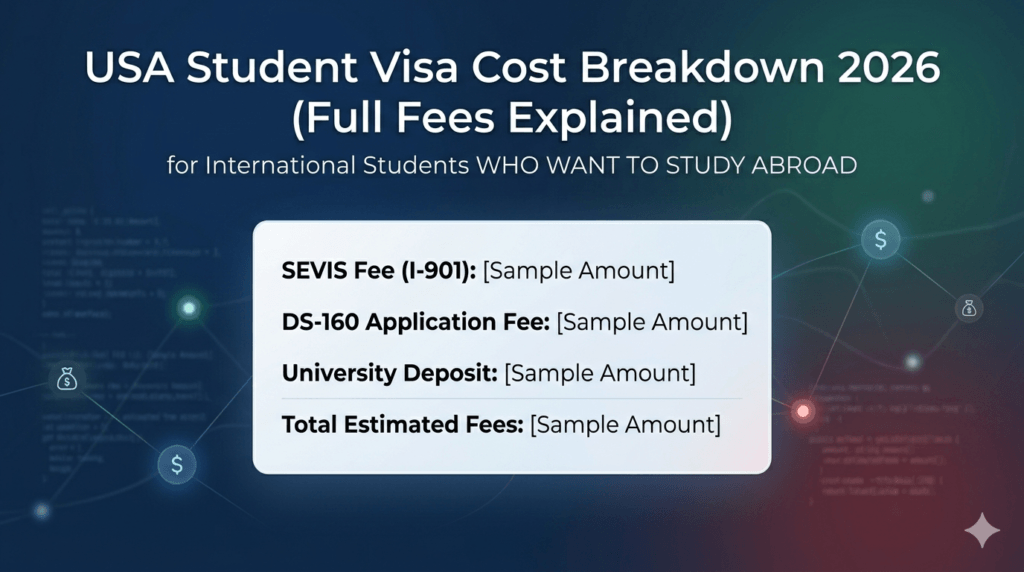
In 2026, the cost of securing an F1, M1, or J1 visa remains a multi-step investment. While the base application fees are standardized, secondary costs—such as university-specific SEVIS processing, health insurance premiums, and potential “reciprocity fees” based on your home country—can vary significantly. Whether you are heading to a prestigious Ivy League or a specialized vocational school, this breakdown will help you budget every dollar needed to transition from an applicant to a registered student in the United States.
Key Expenses for Your USA Student Visa
To get your visa stamped, you’ll need to clear several financial hurdles. Here is what to expect for the 2026 cycle:
- SEVIS I-901 Fee: A mandatory fee paid to the Department of Homeland Security to support the system that tracks international students.
- MRV Fee (Visa Application): The non-refundable machine-readable visa fee required to schedule your interview at the U.S. Embassy.
- Visa Reciprocity Fee: Depending on your country of citizenship, you might pay an additional “issuance fee” once the visa is approved.
- Mandatory Health Insurance: Most U.S. institutions require you to purchase an approved health plan, which is a significant annual cost.
- Living Expenses & Maintenance: You must prove you have enough liquid assets to cover at least one full year of room, board, and personal costs.
USA Student Visa Fee Breakdown 2026
Below is a detailed comparison of the primary costs associated with the most common student visa types.
| Fee Type | F1 (Academic) | M1 (Vocational) | J1 (Exchange) |
| SEVIS I-901 Fee | $350 | $350 | $220 |
| MRV Application Fee | $185 | $185 | $185 |
| Visa Issuance Fee | Varies by Country | Varies by Country | Varies by Country |
| I-20/DS-2019 Processing | $0 – $100 | $0 – $100 | Varies by Sponsor |
| Estimated Health Insurance | $1,500 – $3,000 | $1,500 – $3,000 | $1,000 – $2,500 |
Frequently Asked Questions (FAQs)
1. Is the SEVIS fee refundable if my visa is denied?
No, the I-901 SEVIS fee is non-refundable. However, if you reapply for the same visa type within 12 months, you generally do not have to pay it again.
2. Can I pay the USA student visa fee in my local currency?
Yes, the MRV fee is usually paid in the local currency at a rate determined by the U.S. Consulate, though it is pegged to the USD amount ($185).
3. Do dependents (F2/M2) have to pay the SEVIS fee?
No, spouses and children traveling as dependents do not need to pay a separate SEVIS fee, though they must pay their own MRV application fees.
4. What is a “Reciprocity Fee”?
This is an additional fee charged to citizens of certain countries based on how that country charges U.S. citizens for similar visas. Check the Department of State’s reciprocity table for your specific country.
5. How much “Proof of Funds” do I need for the F1 visa interview?
You must prove you can cover the total “Estimated Cost of Attendance” listed on your Form I-20, which includes tuition, living expenses, and insurance for one year.
6. Has the student visa fee increased in 2026?
As of early 2026, the MRV fee remains at $185. However, it is always best to check the official “Travel.State.Gov” site for mid-year adjustments.
7. Can a sponsor pay my student visa fees?
Yes, a sponsor (parent, relative, or organization) can pay your SEVIS and MRV fees. You just need to ensure you have the official receipts in your name for the interview.
8. Is there a way to waive the US student visa fee?
Fee waivers are extremely rare and usually only apply to certain U.S. government-sponsored exchange programs (G-series) or specific diplomatic cases.
9. How long is the SEVIS fee valid?
The SEVIS fee payment is generally valid for one year from the date of payment until you are issued a visa and enter the United States.
10. What are the common “hidden costs” of moving to the USA?
Besides the visa, budget for airfare ($800–$2,000), a laptop/tech for studies, and a “settling-in” fund for apartment deposits and utilities.
Official Resources for International Students
For the most accurate and up-to-date information, always refer to these official government channels:
- Travel.State.Gov – Official U.S. Department of State visa information.
- Study in the States – DHS portal for understanding the SEVIS process.
- FMJfee.com – The only official site to pay your I-901 SEVIS fee.
- EducationUSA – A network of international student advising centers.
- USCIS.gov – Information on maintaining your status and work authorizations.
Englopak is Pakistan’s premier gateway for international education, career development, and language proficiency. Founded on the principle of bridging the gap between local potential and global excellence, we provide a 360-degree ecosystem for students and professionals aiming for the USA, UK, Germany, Norway, and beyond.
Furthermore, we understand that a global journey is more than just an application—it is a life-changing transition. Consequently, we prioritize technical accuracy in document attestation, financial certification, and interview preparation.
At Englopak, your global future isn’t just a dream—it’s a plan.
Phone Numbers
1. Rawalpindi : 0315 9117529
2. Islamabad: 0315 9956772
3. Peshawar: 0342 0092051
Info@englopak.com
Englopakdigital@gmail.com
Englopakinstitutes@gmail.com