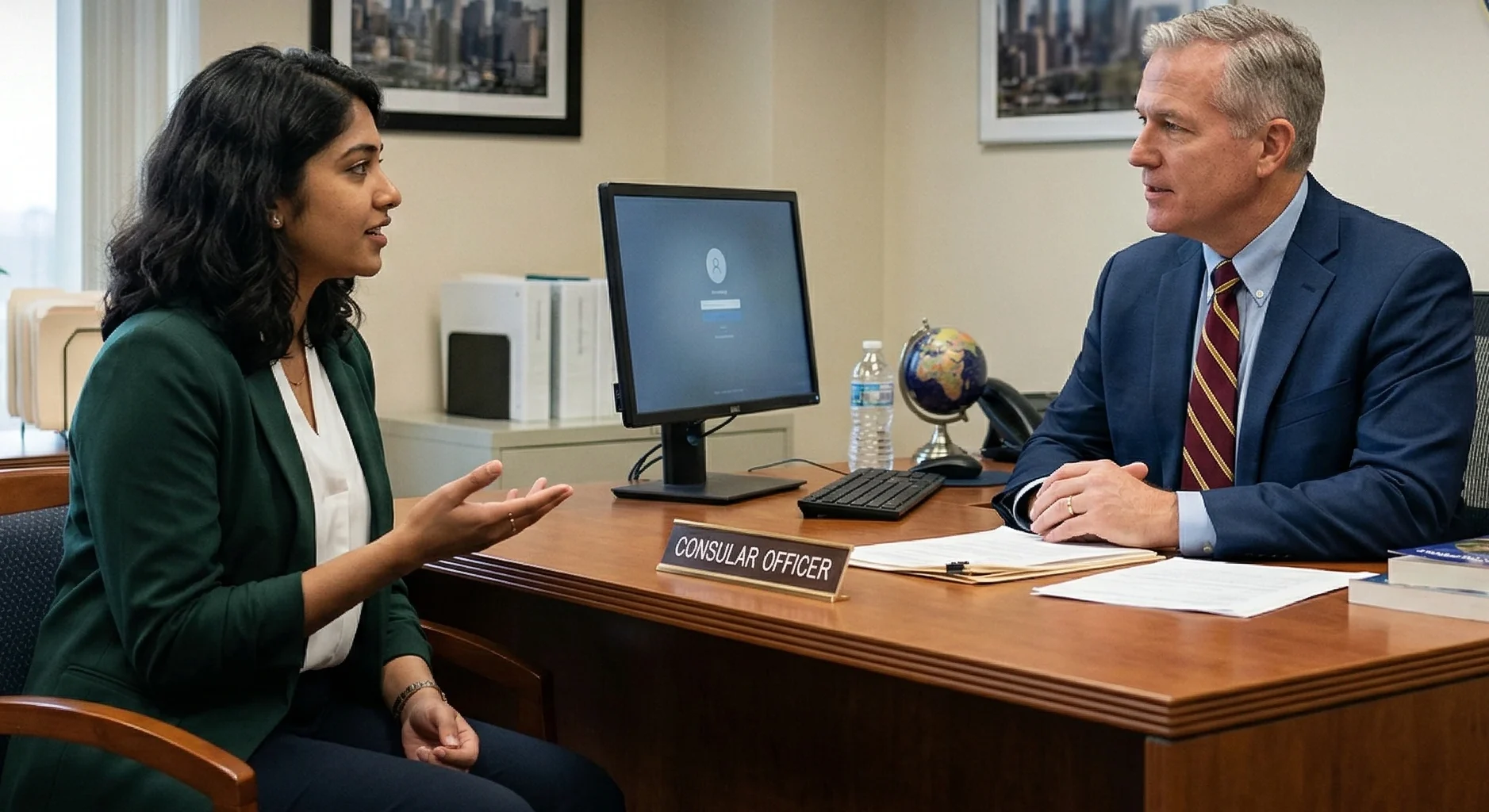
To begin with, the US Department of State has implemented stricter vetting for certain regions in 2026. Therefore, your interview is not just a conversation; it is a verification of your I-20 and DS-160 details. Specifically, the officer is looking for “non-immigrant intent.” Indeed, under Section 214(b) of the Immigration and Nationality Act, every applicant is presumed to be an intending immigrant until they prove otherwise. In addition, the interview typically lasts only 2 to 3 minutes. Consequently, every word you speak must add value to your case
Category 1: Academic Intent and University Choice
The first set of USA F1 Visa Interview Questions and Answers 2026 usually focuses on your university. The officer wants to know if you are a genuine student or just someone trying to enter the US labor market.
Common Questions:
- Question: Why did you choose this specific university?
- Active Answer: “I chose the University of Illinois because its Computer Science department ranks in the top 5 globally for AI research. Furthermore, I have been following the work of Professor John Doe, whose research in neural networks matches my thesis proposal.”
- Question: Why not study this course in your home country?
- Active Answer: “While Pakistan offers excellent engineering programs, the US provides a flexible curriculum that allows me to combine data science with business analytics. Moreover, the hands-on research facilities at [University Name] are unavailable in local institutions.”
Category 2: Financial Capability (The 28-Day Rule and Sponsorship)
Above all, the US government must ensure you will not become a “public charge.” Therefore, the financial portion of the USA F1 Visa Interview Questions and Answers 2026 is often where most rejections occur.
Proof of Funds for 2026:
- Question: Who is sponsoring your education, and what is their income?
- Active Answer: “My father is my primary sponsor. Specifically, he earns £60,000 annually as a Senior Director at [Company Name]. In addition, we have liquidated £45,000 in a dedicated savings account to cover my first year of tuition and living costs.”
- Question: What is the cost of your first year?
- Active Answer: “The total cost is $42,500, as stated on my I-20. Consequently, my father’s savings cover this entire amount, with a $10,000 buffer for emergencies.”
Category 3: Proving “Strong Ties” to Your Home Country
To clarify, “Strong Ties” are the social, economic, and family connections that compel you to leave the US after your studies. Indeed, this is the most critical part of the interview.
2026 Document Checklist for F1 Visa
Finally, do not arrive at the embassy empty-handed. Specifically, you should organize your folder in this order:
- Valid Passport (Valid for at least 6 months).
- DS-160 Confirmation Page (With the barcode).
- SEVIS I-901 Fee Receipt ($350 in 2026).
- Original I-20 (Signed by you and the DSO).
- Bank Statements (Originals only).
A Sample Interview Script: Real-World Scenario
To ensure you are fully prepared, let us examine a successful mock interview script. Specifically, observe how the applicant uses active verbs and clear transition words to lead the conversation.
Visa Officer (VO): Good morning. I see you are going to Arizona State University. Why this school? Applicant: Good morning, Officer. I chose ASU specifically because its Global Logistics program ranks in the top three nationally. Furthermore, the curriculum includes a mandatory internship that aligns with my goal of modernizing my family’s supply chain business in Karachi.
VO: Who is funding this $50,000 annual expense? Applicant: My mother is sponsoring my education. Indeed, she has maintained a fixed deposit of $60,000 for over two years. In addition, her annual income as a Chief Surgeon provides a continuous fund for my remaining years.
VO: What are your plans after you graduate? Applicant: I will return to Pakistan immediately. Consequently, I plan to apply the automated logistics techniques I learn at ASU to reduce operational costs in our local textile industry.
Behavioral Psychology: The Secret to “Green” Interviews
Similarly to how we optimize a blog for readability, you must optimize your behavior for the visa officer. In fact, officers make their primary decision within the first 60 seconds.
- Maintain Eye Contact: Indeed, looking at the officer shows confidence. Conversely, looking down suggests you are hiding something.
- Be Concise: Because the officer has hundreds of cases, you should keep your answers under 30 seconds. Therefore, focus on the “Active” part of your answer immediately.
- Avoid Scripted Responses: Although you should prepare, you must not sound like a robot. Instead, speak naturally and show genuine enthusiasm for your chosen major.
Understanding 214(b) Rejections (And How to Avoid Them)
To clarify, the most common reason for a “pink slip” (rejection) is Section 214(b). Specifically, this means the officer believes you intend to stay in the USA permanently.
How to Overcome a 214(b) Denial:
- Re-evaluate your ties: Specifically, do you have property, a job offer, or family responsibilities in your home country?
- Clarify your finances: If your bank statement was confusing, provide a simplified “Summary Statement” from your bank.
- Change of Circumstance: Indeed, you should only reapply if you can show a significant change in your profile or a better explanation of your intent.
Final Checklist for Success
To summarize, your success at the US Embassy depends on three pillars: Clarity, Finance, and Ties. Therefore, follow this final checklist before you leave for your appointment:
- Active Verbs: Use “I plan,” “I chose,” and “I researched.”
- Transition Words: Use “Furthermore,” “Specifically,” and “Consequently.”
- Organized Folder: Ensure your I-20 and SEVIS receipt are on top.
Conclusion
Passing the USA F1 Visa Interview 2026 is about transparency, precise data, and unshakeable confidence in your plan to return home. By optimizing your F1 strategy—focusing on the CA$22,895 fund rule, specific course modules, and verifiable sponsor data—you replace standard answers with undeniable evidence of your “Genuine Intent.” Remember, the officer is not trying to fail you; they are trying to ensure you are exactly who you claim to be. Specifically, treat the 3-minute interview not as an interrogation but as a chance to sell the official roadmap to your future.
FAQ: Top 10 USA F1 Visa Interview Questions 2026
What is the visa fee for F1 in 2026?
Currently, the F1 visa application fee is £150. Specifically, you must also pay a separate £85 biometrics fee before you book your embassy appointment.
How long does an F1 credibility interview last?
Typically, the in-person embassy interview lasts 3 to 7 minutes. However, the automated vetting and manual review that happen beforehand are far more extensive.
Is the GIC mandatory for USA visas in 2026?
No. Specifically, the Guaranteed Investment Certificate (GIC) is a Canadian requirement. For the USA, you use the I-20 form to show the required CA$22,895 living cost proof to the embassy.
Can I work full-time during the summer on an F1 visa?
Yes. International students on a valid F1 visa can work up to 40 hours per week during their official university vacations (Christmas, Easter, and summer). Specifically, you must ensure it is classified as a “vacation period” by your department.
What is the “Genuine Student” test for Australia?
This is a comprehensive set of logic-based questions designed to replace the GTE statement. Specifically, it asks about your academic logic, financial history, and future career path in your home country.
Can my parents sponsor me for a USA visa in 2026?
Yes. Parents are the most credible sponsors. Specifically, you must provide their FBR tax returns (last 3 years) and bank statements showing a consistent history of the required funds.
What happens if I lie during my F1 interview?
This is considered visa fraud. Specifically, any sign of intentional misrepresentation (like submitting forged documents) will lead to an immediate, permanent ban on entering the USA.
Do visa officers check my social media?
Yes. In 2026, many embassies utilize automated digital vetting. Specifically, they may check LinkedIn to ensure your professional history matches your visa application data.
Can I switch from a visitor visa to a student visa in the USA?
No. The Home Office has officially banned “visa hopping” in 2026. Therefore, you must return to your home country to apply for a formal F1 student visa.
How do I improve my visa success rate if I have a 3.0 CGPA?
You should focus heavily on your Study Logic (SOP). Specifically, explain how this degree is a value addition to your specific career path in Pakistan, not just another degree.

Englopak is Pakistan’s premier gateway for international education, career development, and language proficiency. Founded on the principle of bridging the gap between local potential and global excellence, we provide a 360-degree ecosystem for students and professionals aiming for the USA, UK, Germany, Norway, and beyond.
Furthermore, we understand that a global journey is more than just an application—it is a life-changing transition. Consequently, we prioritize technical accuracy in document attestation, financial certification, and interview preparation.
At Englopak, your global future isn’t just a dream—it’s a plan.
Phone Numbers
1. Rawalpindi : 0315 9117529
2. Islamabad: 0315 9956772
3. Peshawar: 0342 0092051
Info@englopak.com
Englopakdigital@gmail.com
Englopakinstitutes@gmail.com