How to Open a Bank Account in USA for Students
Navigating the financial landscape in a new country can be overwhelming, but opening a bank account in the USA for students is a crucial step toward financial independence. Whether you are arriving on an F-1 or J-1 visa, having a local account allows you to avoid hefty international transaction fees, pay your tuition seamlessly, and manage daily expenses like rent and groceries. Most major U.S. banks offer specialized student checking accounts that come with waived monthly maintenance fees and low minimum balance requirements, making them ideal for those on a tight academic budget.
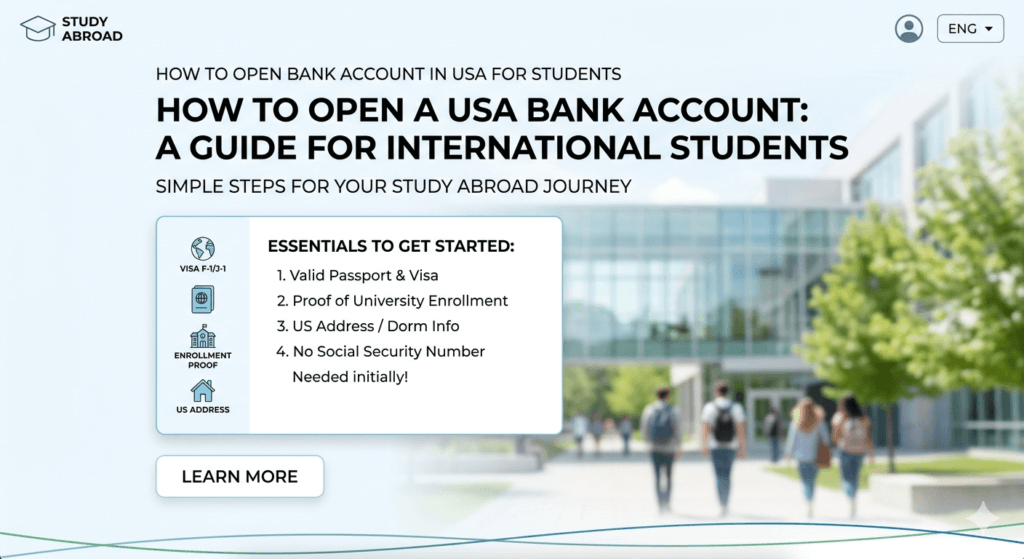
While the process typically requires an in-person visit to a local branch, many modern banks and digital-first platforms have streamlined the experience for international arrivals. You don’t always need a Social Security Number (SSN) to get started; many institutions accept a passport and university enrollment documents instead. By setting up your account early, you also begin the journey of establishing a U.S. credit history, which is essential if you plan to stay for internships or post-graduate work.
Steps to Open Your Student Bank Account
- Research Student-Specific Accounts: Look for “Student Checking” options at banks like Chase, Bank of America, or Wells Fargo to avoid monthly fees.
- Gather Essential Documentation: You will need your Passport, I-20 (for F-1 students) or DS-2019 (for J-1 students), and proof of a U.S. physical address.
- Visit a Branch In-Person: Most traditional banks require you to meet with a personal banker to verify your original documents.
- Prepare an Initial Deposit: Most accounts require a small opening deposit, usually ranging from $25 to $100.
- Request a Debit Card: Ensure you receive a Visa or Mastercard debit card for daily purchases and ATM withdrawals.
- Set Up Mobile Banking: Download the bank’s app to track your spending and use features like Zelle for instant peer-to-peer transfers.
Top Bank Comparison for International Students (2026)
| Bank Name | Best Feature | Monthly Fee | SSN Required? |
| Chase Bank | Largest ATM Network | $0 for Students (17-24) | No (Passport/I-20) |
| Bank of America | Digital Banking Tools | $0 for Students < 25 | No (With 2 IDs) |
| Wells Fargo | On-Campus Presence | $0 for Students (17-24) | No (Passport/Visa) |
| Capital One | High-Interest Savings | $0 (360 Checking) | Generally Yes |
| Wise (Digital) | International Transfers | $0 | No (Online Setup) |
Frequently Asked Questions (FAQs)
1. Can an international student open a bank account in the USA online?
Most traditional U.S. banks require international students to visit a branch in person to verify their visa and I-20 form. However, digital platforms like Wise or Revolut allow you to start the process online before you even arrive.
2. Do I need a Social Security Number (SSN) to open an account?
No, many banks allow international students to open an account using their Passport and I-20 form. You may need to fill out a Form W-8BEN to certify your foreign status for tax purposes.
3. What is the difference between a Checking and Savings account?
A Checking Account is for your daily spending (debit card, rent, bills), while a Savings Account is for holding money long-term and earning a small amount of interest.
4. How much money do I need to open a student account?
The initial deposit is usually very low, often between $25 and $100. Some student-specific accounts may even have a $0 initial deposit requirement.
5. Is there a monthly fee for student bank accounts?
Most major banks waive the monthly maintenance fee for students under the age of 25 or those enrolled in a college/university.
6. Can I use my home country’s address to open the account?
No, U.S. banks require a U.S. physical address (dormitory or apartment) to open an account. You cannot use a P.O. Box in most cases.
7. How long does it take to get a debit card?
Once the account is opened, your physical debit card usually arrives at your U.S. address via mail within 5 to 10 business days.
8. Can my parents send money from abroad to my U.S. account?
Yes, you can receive international wire transfers. You will need to provide your parents with your account number and the bank’s SWIFT/BIC code.
9. Are U.S. bank accounts safe for students?
Yes, as long as the bank is FDIC-insured, your deposits are protected by the U.S. government up to $250,000.
10. Can I keep my account after I graduate?
Yes, but the bank may convert your “Student Account” into a standard “Adult Account,” which might carry monthly fees unless you meet certain balance requirements.
Official Resources & Websites
Social Security Administration (SSA): Guidance on how to apply for an SSN if you get an on-campus job.
U.S. Department of Homeland Security (Study in the States): Official guide on financial rules for F and M students.
Chase Bank Student Center: Direct link to Chase’s international student requirements.
Bank of America International Student Guide: Resources for non-resident account opening.
FDIC Consumer Resource Center: Information on how your money is protected in the U.S.

Englopak is Pakistan’s premier gateway for international education, career development, and language proficiency. Founded on the principle of bridging the gap between local potential and global excellence, we provide a 360-degree ecosystem for students and professionals aiming for the USA, UK, Germany, Norway, and beyond.
Furthermore, we understand that a global journey is more than just an application—it is a life-changing transition. Consequently, we prioritize technical accuracy in document attestation, financial certification, and interview preparation.
At Englopak, your global future isn’t just a dream—it’s a plan.
Phone Numbers
1. Rawalpindi : 0315 9117529
2. Islamabad: 0315 9956772
3. Peshawar: 0342 0092051
Info@englopak.com
Englopakdigital@gmail.com
Englopakinstitutes@gmail.com