Navigating the financial world as a college student in 2026 is significantly easier than it was a decade ago. With the rapid expansion of the starter credit card market—now valued at over $368 billion—issuers are more competitive than ever, offering high-tier rewards that were once reserved for premium cardholders. For a student, the right card is more than just a payment method; it is a vital tool for building a robust credit history while earning cash back on daily essentials like textbooks, dining, and late-night study snacks.
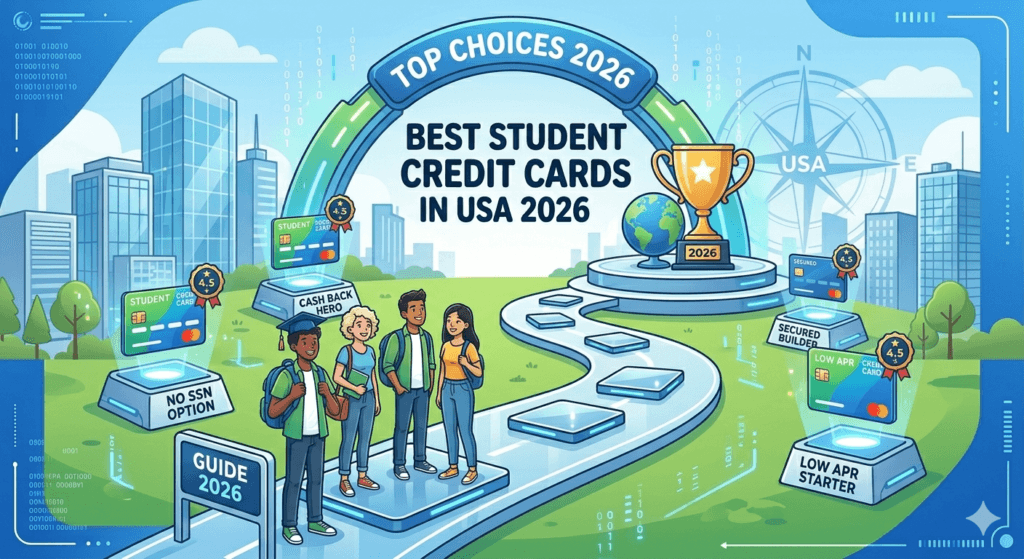
Selecting the best student credit cards in USA 2026 requires a balance between low fees and high utility. Most top-tier options now feature $0 annual fees and introductory 0% APR periods, allowing you to manage your budget without the burden of immediate interest. As digital payments and AI-driven credit assessments become the norm, students with little to no credit history have a better chance of approval than ever before, provided they choose a card tailored to their specific spending habits.
Top Features of 2026 Student Cards
- Zero Annual Fees: Virtually all top student cards in 2026 have eliminated annual fees to remain competitive.
- Automatic Credit Limit Reviews: Many issuers now use AI to automatically review and increase your credit limit after 6-7 months of on-time payments.
- Credit Education Tools: Built-in access to FICO or VantageScore 4.0 tracking is now a standard feature.
- Welcome Bonuses: Look for “Cashback Matches” or $50–$200 sign-up bonuses that can be triggered by low initial spending.
- Foreign Transaction Fee Waivers: Essential for students planning a semester abroad.
Comparison of Best Student Credit Cards 2026
| Card Name | Best For | Rewards Rate | Welcome Offer | Recommended Credit |
| Discover it® Student Cash Back | Overall Rewards | 5% Rotating Categories | First-Year Cashback Match | No Credit / New |
| Capital One SavorOne Student | Dining & Streaming | 3% Dining, Grocery, Ent. | $50 after $100 spend | Fair / Average |
| Chase Freedom Rise® | Starting from Scratch | 1.5% Flat Rate | $25 for Autopay (Typical) | No Credit |
| BofA Travel Rewards for Students | Study Abroad | 1.5 Points per $1 | 25,000 Points | Good / Excellent |
| Discover it® Student Chrome | Gas & Commuting | 2% Gas & Dining | First-Year Cashback Match | No Credit / New |
Frequently Asked Questions (FAQs)
1. Can I get a student credit card with no credit history in 2026?
Yes. Cards like the Chase Freedom Rise and Discover it® Student Cash Back are specifically designed for beginners and often do not require a prior credit score for approval.
2. What is the minimum age to apply for a student card?
You must be at least 18 years old. However, if you are under 21, you must prove independent income or have a co-signer to comply with federal lending laws.
3. Do student credit cards charge annual fees?
Most do not. To rank as a “top” card in 2026, issuers like Capital One and Discover ensure $0 annual fees to attract college-aged users.
4. How does the “Cashback Match” work?
Offered primarily by Discover, they will match every dollar of cash back you earn at the end of your first year, effectively doubling your rewards.
5. Will applying for a card hurt my credit score?
A “Hard Inquiry” may cause a temporary dip of 5–10 points, but the long-term benefit of building credit far outweighs this minor initial drop.
6. Can international students apply for these cards?
Yes, many issuers accept a Social Security Number (SSN) or an Individual Taxpayer Identification Number (ITIN) from international students.
7. What happens to my card after I graduate?
Most student cards automatically “graduate” to a standard adult version of the card, allowing you to keep your credit age and history intact.
8. What is a good starting credit limit for a student?
Typical starting limits range from $300 to $1,000, though these can be increased quickly with responsible use.
9. Are there any cards that reward good grades?
While less common in 2026 than in previous years, some cards still offer “Good Grade Rewards” in the form of small statement credits for maintaining a GPA of 3.0 or higher.
10. Is the Capital One SavorOne Student card better than Discover?
It depends on your habits. SavorOne is superior for consistent 3% dining and grocery rewards, while Discover is better for maximizing 5% categories and the first-year match.
Official Resources for Students
AnnualCreditReport.com – The only official site for free credit reports.
Consumer Financial Protection Bureau (CFPB) – Guide to student banking.
Discover Student Cards Official Site – Detailed rates and terms.
Capital One Student Credit Center – Tools for building credit.
Chase Student Credit Resources – Financial literacy for college students.

Englopak is Pakistan’s premier gateway for international education, career development, and language proficiency. Founded on the principle of bridging the gap between local potential and global excellence, we provide a 360-degree ecosystem for students and professionals aiming for the USA, UK, Germany, Norway, and beyond.
Furthermore, we understand that a global journey is more than just an application—it is a life-changing transition. Consequently, we prioritize technical accuracy in document attestation, financial certification, and interview preparation.
At Englopak, your global future isn’t just a dream—it’s a plan.
Phone Numbers
1. Rawalpindi : 0315 9117529
2. Islamabad: 0315 9956772
3. Peshawar: 0342 0092051
Info@englopak.com
Englopakdigital@gmail.com
Englopakinstitutes@gmail.com