USA Student Loan Options for International Students 2026
Navigating the landscape of higher education in the United States as an international student is an ambitious journey that often comes with a significant price tag. In 2026, the cost of tuition, housing, and specialized lab fees at top-tier American universities continues to rise, making external financing a necessity for many. Since most international students are ineligible for U.S. federal financial aid (FAFSA), the market has shifted toward innovative private lending solutions. These modern lenders now utilize “future-potential” algorithms rather than just historical credit scores, allowing bright students from across the globe to secure the funding they need based on their career trajectory and chosen field of study.
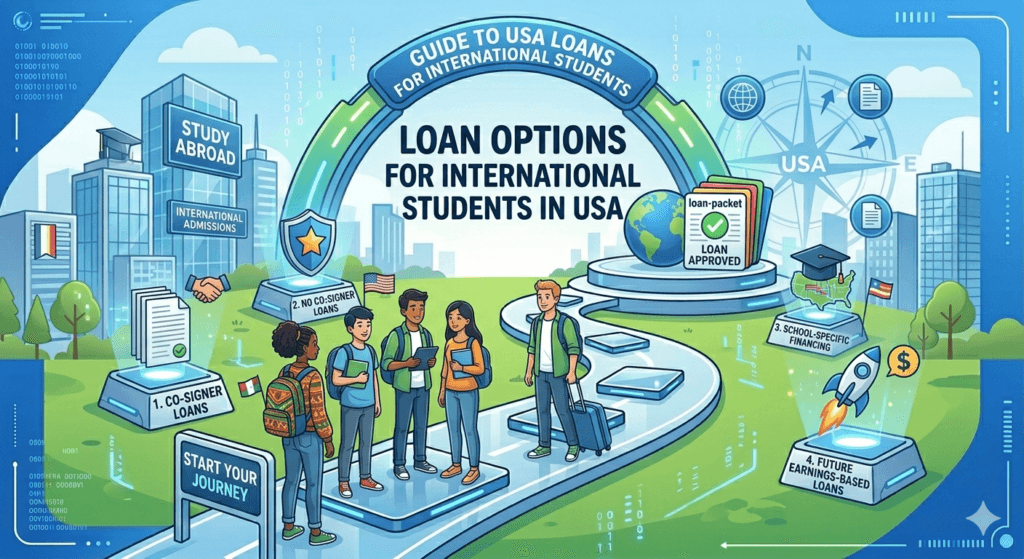
The 2026 lending environment is characterized by increased flexibility and digital-first applications. Whether you are pursuing a STEM degree, an MBA, or a specialized healthcare certification, there are now two primary paths: loans that require a U.S.-based cosigner and “no-cosigner” loans tailored specifically for global citizens. While cosigned loans often offer lower interest rates due to reduced risk, non-cosigner options like those from MPOWER or Prodigy Finance have become the gold standard for students who lack domestic ties in the U.S. Understanding the nuances of fixed versus variable rates, grace periods, and visa support letters is essential to choosing a plan that won’t burden your future professional life.
Loan Options
1. Private Lenders
- Prodigy Finance
- MPOWER Financing
2. University Loans
- Offered by some institutions
3. Co-signer Loans
- Require US-based guarantor
Comparison
| Type | Requirement | Best For |
|---|---|---|
| Private | No co-signer (some) | International students |
| Co-signer | US citizen | Lower interest |
Tips to Get Approved
- Strong academic record
- Admission letter
- Choose recognized universities
Important Note
Always compare interest rates before applying.
Key Features of 2026 International Student Loans
- No-Cosigner Availability: Many lenders now offer loans based on your university’s ranking and your expected post-graduation salary.
- Visa Support Letters: Leading lenders provide “Proof of Funds” letters required for your F-1 or J-1 visa interview.
- Interest Rate Discounts: Look for “Auto-Pay” discounts (usually 0.25%) and “Graduation Discounts” offered by top providers.
- Global Access: Students from over 150 countries are now eligible for U.S. study loans without needing a U.S. credit history.
- Flexible Repayment: Most 2026 loan products offer interest-only payments while in school, with full principal repayment starting 6 months after graduation.
Top USA Student Loan Lenders for International Students 2026
| Lender Name | Best For… | Max Loan Amount | Cosigner Required? | Estimated APR Range |
| MPOWER Financing | No-Cosigner / STEM | $100,000 (Lifetime) | No | 9.99% – 15.89% |
| Prodigy Finance | Graduate / MBA | 100% Cost of Attendance | No | 9.65% – 16.50% |
| Sallie Mae | Undergraduate / Flexible | School-Certified Cost | Yes (U.S. Resident) | 5.50% – 14.50% |
| Ascent | Career-Based Loans | $200,000 | Optional | 6.00% – 15.50% |
| SoFi | High-Credit Cosigners | Full Cost | Yes | 5.25% – 13.95% |
Frequently Asked Questions (FAQs)
1. Can international students get FAFSA in 2026?
No, federal student aid is generally reserved for U.S. citizens and eligible non-citizens (like green card holders). International students must rely on private lenders or scholarships.
2. What is a “No-Cosigner” loan?
It is a loan where the lender does not require a U.S. citizen to guarantee the debt. Instead, they look at your academic record, university prestige, and future earning potential.
3. Do I need a U.S. credit score to apply?
Lenders like MPOWER and Prodigy Finance do not require a U.S. credit history. However, they may check your credit report from your home country.
4. How soon can I apply for a 2026 student loan?
You can usually start the process once you have been accepted into an eligible U.S. university. It is recommended to apply at least 3–4 months before your classes start.
5. Does a student loan help with my F-1 visa?
Yes. Once your loan is approved, lenders provide a “Visa Support Letter” which acts as official proof of financial capacity during your visa interview at the U.S. Embassy.
6. Are interest rates fixed or variable in 2026?
Both options exist. Fixed rates stay the same for the life of the loan, while variable rates fluctuate based on market indices like SOFR.
7. Can I pay off my loan early?
Most reputable international lenders (like those in our table) do not charge “prepayment penalties,” meaning you can pay back the loan faster to save on interest.
8. What expenses do these loans cover?
They typically cover “Cost of Attendance,” which includes tuition, housing, food, books, and even health insurance.
9. Is there a grace period after graduation?
Yes, most lenders offer a 6-month grace period after you graduate before you are required to start making full principal and interest payments.
10. Which degree programs are most likely to get approved?
STEM (Science, Technology, Engineering, Math), MBA, and Healthcare degrees have the highest approval rates due to the strong job market in these fields.
Top 5 Official Resources for International Students
- InternationalStudentLoan.com – A comprehensive comparison tool for finding lenders.
- MPOWER Financing – Specialized no-cosigner loans for 400+ U.S. schools.
- Prodigy Finance – Global lender focusing on graduate students and MBAs.
- EduPass – A leading guide for international students planning to study in the U.S.
- IEFA.org – International Education Financial Aid database for scholarships and loans.

Englopak is Pakistan’s premier gateway for international education, career development, and language proficiency. Founded on the principle of bridging the gap between local potential and global excellence, we provide a 360-degree ecosystem for students and professionals aiming for the USA, UK, Germany, Norway, and beyond.
Furthermore, we understand that a global journey is more than just an application—it is a life-changing transition. Consequently, we prioritize technical accuracy in document attestation, financial certification, and interview preparation.
At Englopak, your global future isn’t just a dream—it’s a plan.
Phone Numbers
1. Rawalpindi : 0315 9117529
2. Islamabad: 0315 9956772
3. Peshawar: 0342 0092051
Info@englopak.com
Englopakdigital@gmail.com
Englopakinstitutes@gmail.com