Navigating the Cost of Living in USA for Students 2026 requires a strategic approach, as the landscape of American higher education and urban economics continues to shift. For international and domestic students alike, budgeting in 2026 isn’t just about tuition; it’s about managing the “hidden” costs of inflation-adjusted rent, rising grocery bills, and mandatory health insurance. While prestigious coastal hubs like New York and San Francisco remain the most expensive, a growing trend sees students flocking to the “Sun Belt” and “Rust Belt” cities—such as Austin, Pittsburgh, and Atlanta—where the quality of life remains high but the monthly overhead is significantly more manageable.
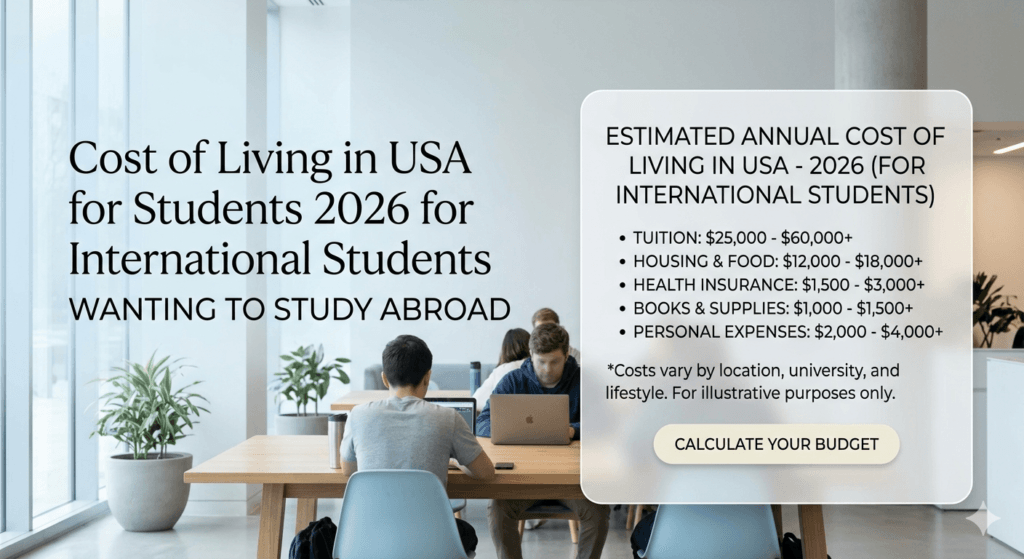
To successfully plan your academic journey, you must distinguish between “fixed” costs like university fees and “variable” lifestyle choices. On average, a student in 2026 should prepare for a monthly expenditure ranging from $1,200 to $2,500 (excluding tuition). This range accounts for everything from shared off-campus housing and public transit passes to the occasional weekend social outing. By leveraging student discounts, choosing cities with lower CPI (Consumer Price Index) ratings, and opting for university-affiliated health plans, students can effectively mitigate the financial pressures of living in the world’s most popular study destination.
Key Factors Influencing Student Costs in 2026
- Geographic Variation: Rent in the Midwest or South can be 40% cheaper than in the Northeast or West Coast.
- Housing Type: Shared off-campus apartments are often more budget-friendly than single on-campus dorms.
- Mandatory Health Insurance: Most US universities require specific coverage, costing between $1,500 and $3,500 per year.
- Inflationary Adjustments: Grocery and utility costs have seen a 3–5% year-over-year increase, making meal-prepping essential.
- Transportation: Many students save by choosing “transit-first” cities or using university-sponsored shuttle systems.
Estimated Monthly Expenses Breakdown (2026)
| Expense Category | Monthly Cost (Budget) | Monthly Cost (Premium) |
|---|---|---|
| Accommodation (Shared/Dorm) | $700 – $1,100 | $1,500 – $2,500+ |
| Food & Groceries | $350 – $500 | $600 – $900 |
| Utilities (Electricity/Water/Net) | $150 – $250 | $300 – $450 |
| Public Transportation | $60 – $100 | $150 – $300 (Inc. Uber) |
| Health Insurance (Monthly Div.) | $150 – $250 | $300 – $400 |
| Books & Supplies | $50 – $100 | $150 – $200 |
| Miscellaneous/Entertainment | $150 – $300 | $500 – $800 |
| Total Estimated Monthly | $1,610 – $2,600 | $3,500 – $5,550+ |
Frequently Asked Questions (FAQs)
1. What is the average cost of living for international students in USA 2026?
On average, international students should budget between $15,000 and $25,000 per year for living expenses, excluding tuition fees.
2. Which are the cheapest US states for students in 2026?
States like Mississippi, Oklahoma, Kansas, and Arkansas currently offer the lowest cost of living for students in terms of rent and groceries.
3. Is on-campus housing cheaper than off-campus in 2026?
Generally, shared off-campus housing is cheaper, but on-campus housing often includes utilities and meal plans, which can simplify budgeting.
4. How much should I budget for health insurance?
Expect to pay between $1,500 and $3,500 annually. Most universities automatically enroll you in their plan unless you prove you have comparable coverage.
5. Can international students work to cover their living costs?
Students on F-1 visas can typically work up to 20 hours per week on-campus during semesters, which can help cover pocket money but rarely the full cost of living.
6. What is the cost of a meal at a US university?
A typical meal at a campus cafeteria costs between $10 and $15, though meal plans can reduce the “per-meal” price significantly.
7. How much do books and supplies cost in 2026?
Students spend roughly $1,000 to $1,300 per year. Using digital textbooks or rental services can cut this by 50%.
8. Are utilities included in the rent?
In many off-campus apartments, utilities like electricity and internet are not included and can add $150–$200 to your monthly bills.
9. Which US cities have the best public transport for students?
New York City, Boston, Chicago, and San Francisco have the best transit, though these cities also have higher rent.
10. How much is the SEVIS fee and Visa fee in 2026?
While subject to change, students should budget approximately $500–$600 for combined SEVIS and visa processing fees before arrival.
Top 5 Official Websites for Student Financial Planning
- Study in the States (DHS.gov): The official government guide for international student requirements and financial ability rules.
- EducationUSA: A Department of State network that provides detailed financial aid and cost-of-living guides.
- College Board – BigFuture: Offers a comprehensive tool to compare the “Net Price” of different US universities.
- USAGov – Financial Aid: The central hub for information on federal grants, loans, and scholarship resources.
- NCES College Navigator: A massive database from the Department of Education to check official tuition and housing stats for any US school.

Englopak is Pakistan’s premier gateway for international education, career development, and language proficiency. Founded on the principle of bridging the gap between local potential and global excellence, we provide a 360-degree ecosystem for students and professionals aiming for the USA, UK, Germany, Norway, and beyond.
Furthermore, we understand that a global journey is more than just an application—it is a life-changing transition. Consequently, we prioritize technical accuracy in document attestation, financial certification, and interview preparation.
At Englopak, your global future isn’t just a dream—it’s a plan.
Phone Numbers
1. Rawalpindi : 0315 9117529
2. Islamabad: 0315 9956772
3. Peshawar: 0342 0092051
Info@englopak.com
Englopakdigital@gmail.com
Englopakinstitutes@gmail.com