Navigating the U.S. healthcare system as an international student in 2026 can feel like solving a complex puzzle. Unlike many countries with universal healthcare, the United States operates on a private insurance model where costs can be astronomical without proper coverage. For students arriving on F-1 or J-1 visas, having a robust health insurance plan is not just a safety net—it is often a legal or institutional requirement.
As of 2026, many universities have shifted toward “hard waiver” systems, meaning you are automatically enrolled in (and billed for) the school’s expensive internal plan unless you can prove you have purchased a private policy that meets or exceeds their strict criteria.
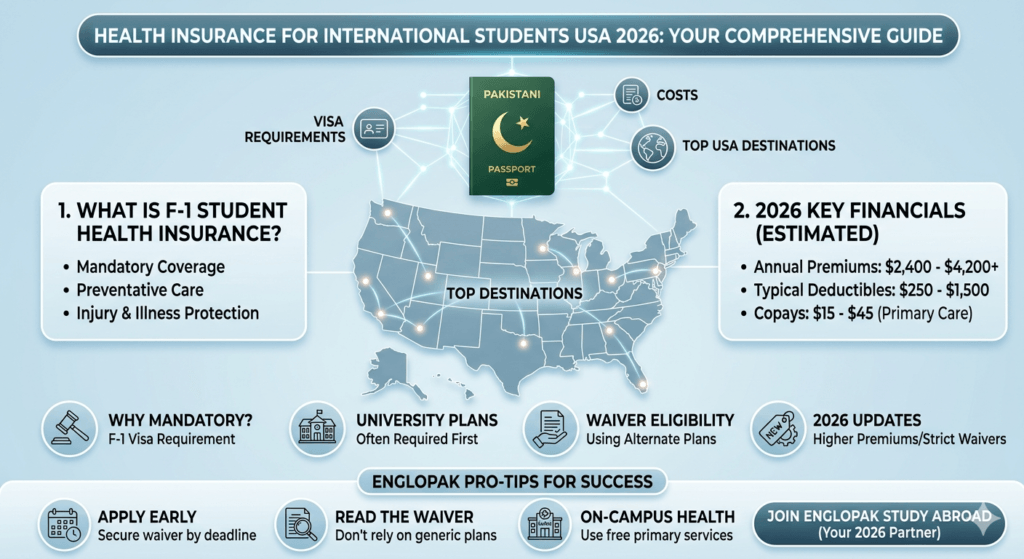
Choosing the right plan in 2026 requires balancing your budget with the specific mandates of your visa and university. While J-1 visa holders must meet federal minimums—such as $100,000 in medical benefits and $50,000 for medical evacuation—F-1 students often face even higher standards set by their individual colleges, including coverage for pre-existing conditions and mental health.
By researching private providers like ISO, IMG, or PSI, students can often find ACA-compliant plans that offer the same protection as university-sponsored insurance but at a fraction of the cost.
Key Requirements & Benefits for 2026
- J-1 Visa Federal Mandates: Must include at least $100,000 per accident/illness, $50,000 for medical evacuation, and $25,000 for repatriation of remains.
- ACA Compliance: Most top-tier universities now require “Affordable Care “Act”-compliant plans, which cover 10 essential benefits including maternity, mental health, and preventative care.
- The Waiver Process: To save money, you must submit a “Waiver Form” to your school before the semester deadline to opt out of their $2,500+ annual insurance bill.
- PPO Networks: Look for plans using established networks like Aetna or UnitedHealthcare to ensure most doctors near your campus will accept your insurance.
- Pre-existing Conditions: In 2026, most reputable student plans no longer have waiting periods for chronic conditions, provided the plan is ACA-compliant.
Top Health Insurance Plans for International Students (2026)
| Plan Name | Best For | Approx. Monthly Cost | Key Feature |
| ISO Care | Budget-conscious F-1 Students | $31 – $90 | Specifically designed to meet university waiver requirements. |
| IMG Patriot Exchange | J-1 Visa Compliance | $50 – $110 | Meets all U.S. Dept of State requirements for exchange visitors. |
| StudentSecure (WorldTrips) | Flexible Coverage Tiers | $45 – $150 | Offers four levels (Elite, Select, Budget, Smart) for different needs. |
| PSI Health Insurance | Specific University Waivers | $60 – $130 | Pre-calculated plans that are guaranteed to meet specific school rules. |
| Cigna Global | Long-term/High-end Coverage | $150+ | Best for students who want premium, worldwide coverage. |
10 FAQs for International Student Health Insurance 2026
1. Is health insurance mandatory for F-1 students in 2026?
While the U.S. government doesn’t legally mandate it for F-1 visas, almost every accredited university requires it for enrollment. You won’t be able to register for classes without proof of insurance.
2. Can I use my health insurance from my home country?
Technically yes, but it rarely works. Most U.S. schools require the insurance company to have a U.S. claims office and a U.S. phone number, which most foreign plans lack.
3. What is a “deductible” in U.S. insurance?
This is the amount you pay out of pocket before the insurance company starts paying. For students, a “good” deductible is usually $100 to $500.
4. What does “Repatriation of Remains” mean?
It is a standard visa requirement that covers the cost of returning a student’s body to their home country in the unfortunate event of death.
5. How do I get a “waiver” for my university insurance?
You buy a private plan (like ISO or PSI), download the “Waiver Form” from your university’s portal, and have the private insurer confirm you are covered. Once approved, the school removes the insurance fee from your tuition bill.
6. Are dental and vision covered in student health plans?
Usually, no. Standard plans cover illnesses and injuries. You typically need to buy a separate “rider” or add-on for dental cleanings and eye exams.
7. Does insurance cover COVID-19 and vaccines in 2026?
Yes, most ACA-compliant plans and university plans treat COVID-19 like any other illness and cover federally mandated vaccines at 100%.
8. What is the difference between a copay and coinsurance?
A Copay is a flat fee (e.g., $25) you pay per visit. Coinsurance is a percentage (e.g., 20%) of the total bill you pay after meeting your deductible.
9. Can I visit any doctor I want?
It’s best to stay “in-network.” Using a doctor who belongs to your insurance’s PPO network (like Aetna or Blue Cross) ensures the lowest rates and direct billing.
10. When should my insurance coverage start?
Your plan should begin the day you depart your home country or, at the latest, the day you land in the United States to ensure you are protected during travel.
Official Resources & Helpful Websites
- Study in the States (DHS): Official government guide for F and M visa holders.
- U.S. Department of State (J-1 Visa): Explains the specific insurance mandates for exchange visitors.
- Healthcare.gov: The official U.S. site for the Affordable Care Act (ACA) standards.
- ISO Student Health Insurance: One of the largest private providers specialized in university waivers.
- NAFSA: Association of International Educators: Provides deep-dive resources on health and safety for international students.

Englopak is Pakistan’s premier gateway for international education, career development, and language proficiency. Founded on the principle of bridging the gap between local potential and global excellence, we provide a 360-degree ecosystem for students and professionals aiming for the USA, UK, Germany, Norway, and beyond.
Furthermore, we understand that a global journey is more than just an application—it is a life-changing transition. Consequently, we prioritize technical accuracy in document attestation, financial certification, and interview preparation.
At Englopak, your global future isn’t just a dream—it’s a plan.
Phone Numbers
1. Rawalpindi : 0315 9117529
2. Islamabad: 0315 9956772
3. Peshawar: 0342 0092051
Info@englopak.com
Englopakdigital@gmail.com
Englopakinstitutes@gmail.com